Chapter 2
How people feel
Almost everything in Rejoice! runs on satisfaction: each person's feeling about their church, from 0 to 1. It decides whether they come, whether they give, whether they stay, and whether visitors come back. Learn how it moves and the rest of the game follows.
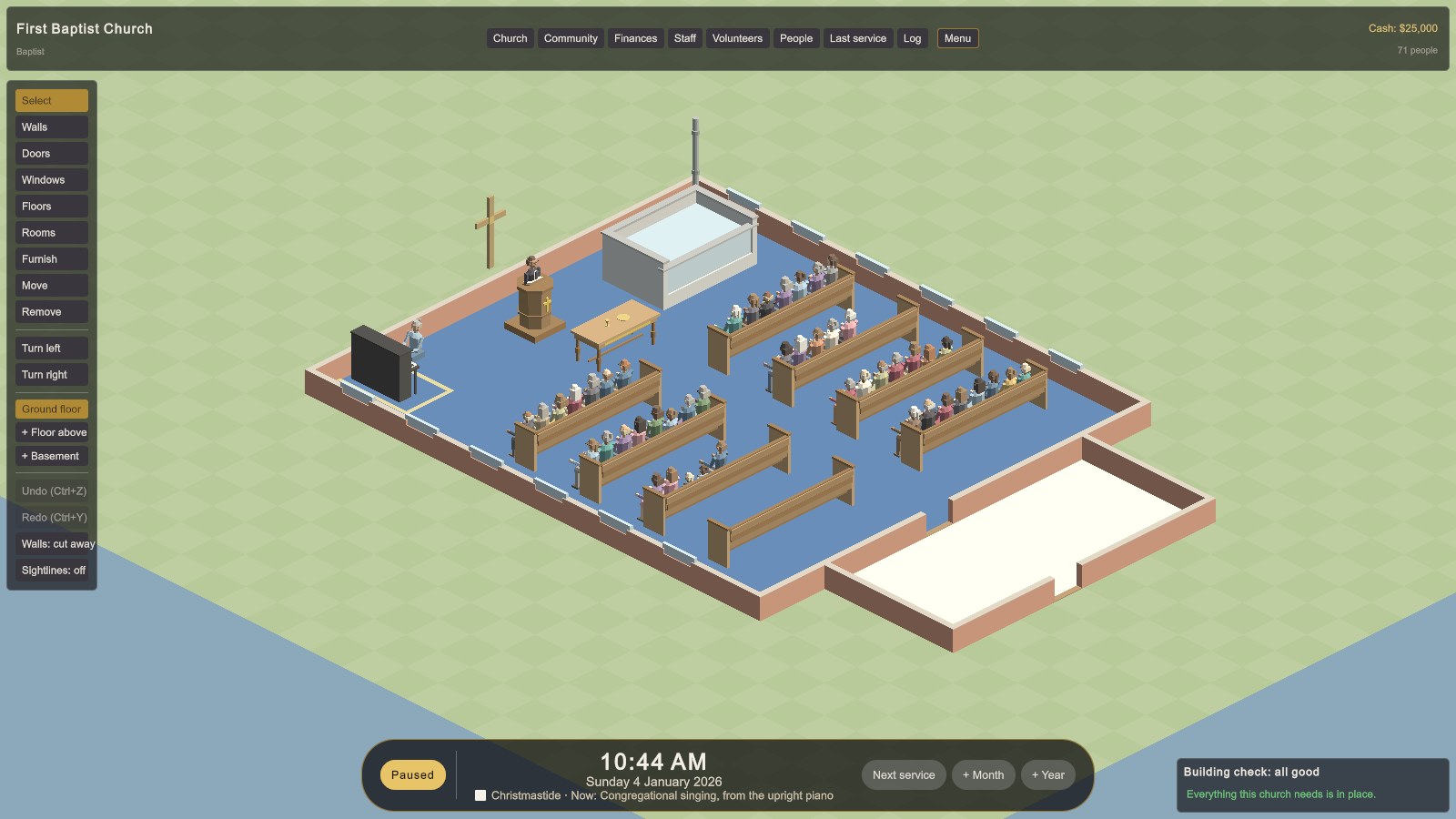
How satisfaction moves
After every service a person attends, everything they experienced is added up as factors: a good seat, the sermon, a cold welcome, a building in disrepair. Their satisfaction then moves toward a target:
target = 0.5 + 0.5 × (the sum of the factors)
- Regulars and members move 15% of the way toward the target each service. They're slow to change and forgiving of one bad Sunday.
- Visitors move 60% of the way. Their first service nearly decides what they think of you.
A church whose factors add up to zero settles everyone at 0.5. That sounds fine, but it's the edge of trouble. Every +0.1 of factors you add lifts the settled level by 0.05. A healthy church wants its people's factors to sum to about +0.2 or more, settling them near 0.6.
The thresholds that matter
| Satisfaction | What happens |
|---|---|
| below 0.25 | They give nothing at all. |
| below 0.45 | Their household starts to drift away. Each month there's a chance of 0.6 × the shortfall below 0.45, cut by 15% for every friend they have in the church. |
| 0.5 | Regulars of a year or more can join as members (15% a month). A visiting household needs more than this even to come back. |
| 0.55 | A visiting household that has come three times and is this happy starts attending regularly. |
| 0.8 | Full giving. Engagement, which scales giving and pledges, rises from nothing at 0.25 to full here. |
Attendance
A household of regulars comes on a given Sunday with a chance of 0.2 + 0.65 × satisfaction, plus 0.1 if anyone in it is a member, capped at 95%. At 0.6, a member household comes about 69% of the time; at 0.45, about 59%. Summer holidays shave June by 7% and July and August by 15%.
A church of 0.5s doesn't collapse, but it doesn't grow either. Visitors don't come back, nobody gives much, and a few bad Sundays tip households into drifting away. Push the factors positive.
Seeing what people feel
The person inspector
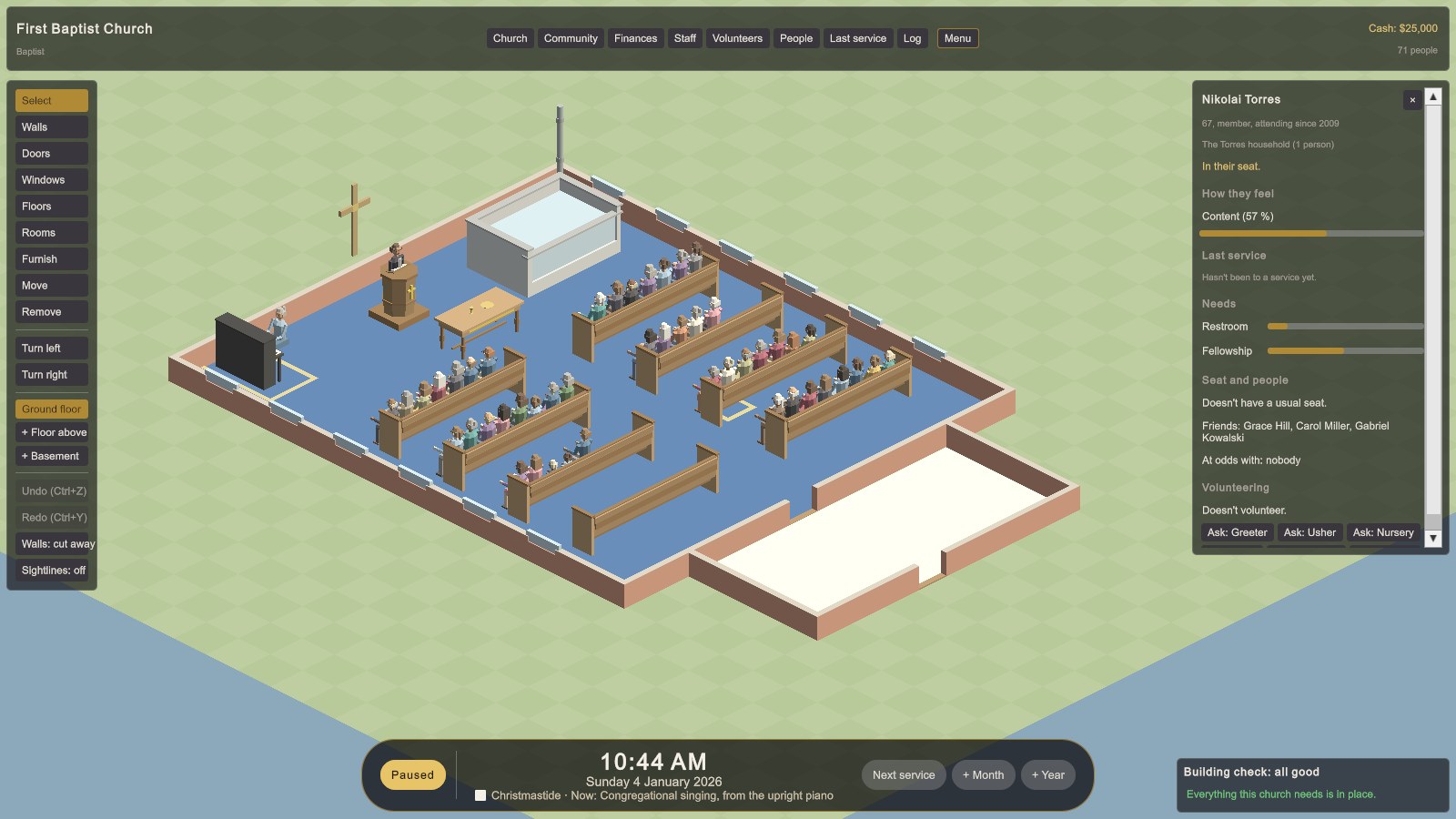
Click anyone in the church to see them. The inspector shows:
- Who they are: age, whether they're a member or a regular and since when, and their household.
- Where they are: in their seat, walking in, standing at the back.
- How they feel: their satisfaction as a word and a bar.
- Last service: every factor that applied to them, positive and negative. This is the most useful thing in the game for finding out what's wrong.
- Needs: how much they need a restroom, fellowship, and so on.
- Seat and people: whether they've claimed a usual seat, their friends, and who they're at odds with.
- Volunteering: what they do, and Ask buttons to recruit them to a role.
The service report
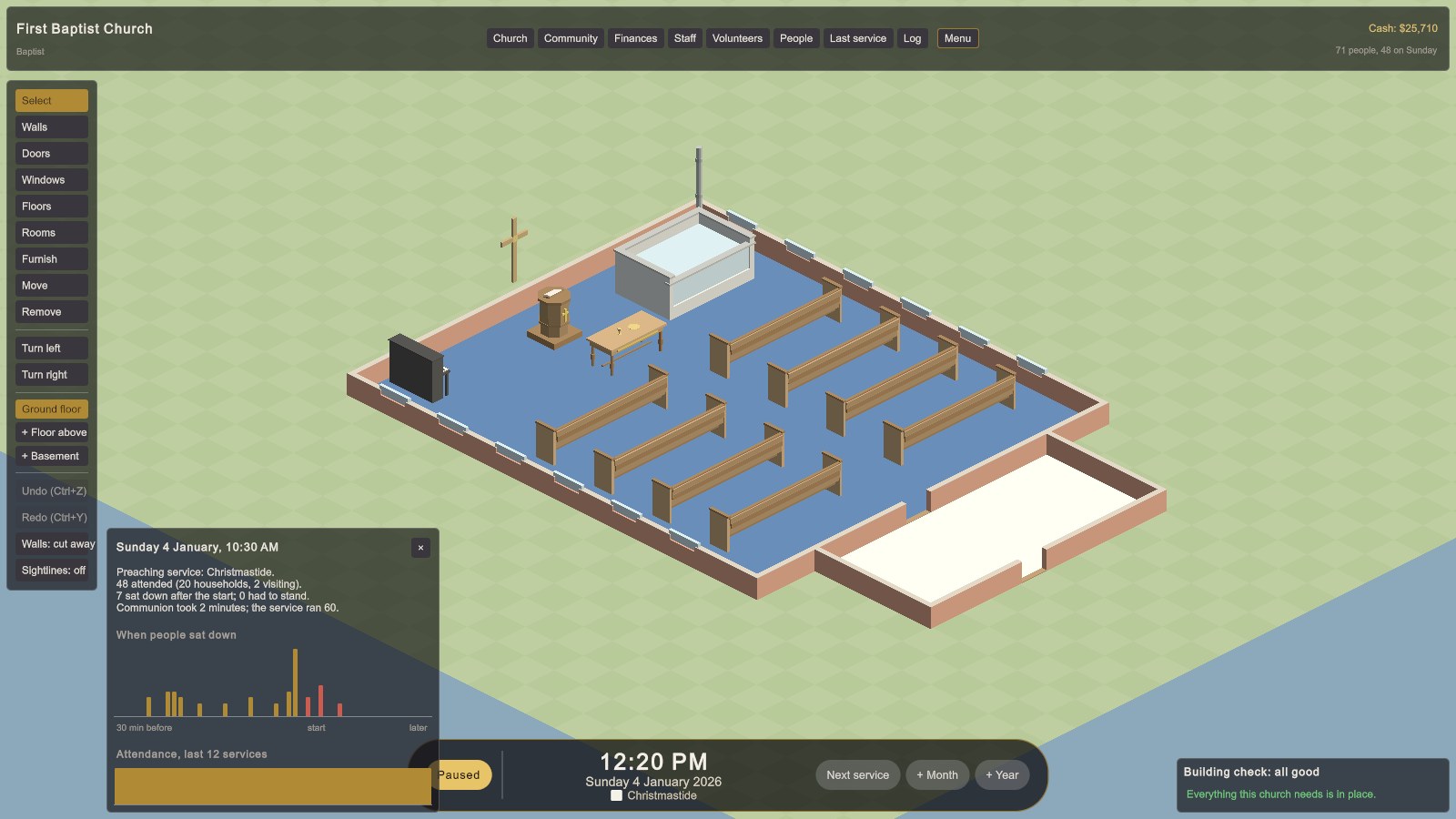
Last service opens the report on the most recent service. Late arrivals show as red bars after the start on the "When people sat down" chart. If many people sit down after the start, your entrance is a bottleneck (see Building your church).
Every factor
These are all the factors scored after a service, roughly from biggest to smallest. "Everyone" means everyone at the service.
The building and the tradition
| Factor | Amount | How to win it |
|---|---|---|
| Building fit | up to ±0.15 | Furnish with what suits the tradition. The fit score is shown in the Furnish palette and in every item's entry in The item catalogue. |
| Required item or room missing | −0.08 each | The building check names them. Missing required and expected things together cost at most −0.3. |
| Expected item or room missing, or a discouraged one present | −0.03 each | A Catholic parish expects statues and an organ; Baptists find statues and icons discouraged. |
| Building in disrepair | up to −0.2 | Applies below 0.5 overall condition. See Keeping the building standing. |
| Architectural style | up to ±0.06 | A style whose formality matches the tradition's: Gothic for high-church traditions, brick for low. |
| Acoustics | up to ±0.05 | Organs and choirs want a ringing room; bands want a dry one. |
| Sightline | down to −0.06 | For a seat whose view of the front is blocked or poor. |
| Seasonal decor | ±0.04 × formality | Traditions with a church year: own paraments and the season's decor. |
| Orientation | ±0.04 | Mostly the Orthodox, who expect the church to face east. |
| Daylight | −0.04 to +0.02 | One plain south-facing window per 10 m² of worship space for full light. |
| Choir loft | +0.02 | With four or more singing from it. |
Sunday morning itself
| Factor | Amount | How to win it |
|---|---|---|
| Had a seat | +0.05 | Enough seats for your busiest service. |
| Had to stand | −0.15 | More seats, or more services (up to four a week). |
| Late to their seat | −0.08 | A crowded narthex or a single door makes a bottleneck. Widen the entrance, add doors, add services. |
| Service ran long | −0.05 per 10 min over (−0.2 at most) | Usually communion for a big crowd. Add communion stations or a longer rail. |
| No restroom | −0.1 | For anyone who needs one: build a restroom. |
| No nursery | −0.08 | For families with infants: a nursery room with a nursery volunteer on duty. |
| Friends at the same service | +0.03 each, up to +0.1 | Friendships form by themselves as people sit together. |
| Someone they resent there | −0.05 | Grudges form by themselves too. |
| Someone in their pew | −0.08 (regular), −0.1 (visitor) | Regulars claim a seat after three Sundays in it. More seats ease it. |
| Ushered to a seat | +0.03 | Visitors, with ushers on duty. |
| Greeted / not greeted | +0.15 / −0.1 | Visitors only. See Growing the congregation. |
Leadership and music
| Factor | Amount | Notes |
|---|---|---|
| Preaching | −0.08 to +0.08 | (pastor's performance − 0.5) × 0.16, for everyone. A skilled, unstretched pastor is worth a lot. |
| The sermon's message | −0.1 to +0.08 | The topic you chose, as your tradition takes it. See Worship and the church year. |
| No pastor | −0.1 | For everyone, except in an unprogrammed Quaker meeting. |
| Choir director / organist / pianist | up to +0.06 | For everyone. |
| Youth director | up to +0.08 | For households with someone under 19. |
| A choir of four or more | +0.04 | For everyone. |
| Ministries that serve them | up to +0.08 | See The church in its community. |
People's own situation
| Factor | Amount | How to win it |
|---|---|---|
| No step-free way in | −0.2 / −0.05 | −0.2 for wheelchair users (who also come only 30% as often), −0.05 for limited mobility (85% as often). Build a ramp at a stepped door, or a lift between levels. |
| Hard of hearing | −0.03 to −0.08, or +0.03 | Worse in a ringing room. A hearing loop turns it into a gain. |
| Worn out volunteering | up to −0.25 | Don't overwork volunteers (Staff and volunteers). |
| A conflict they oppose | −0.06 | Until it's settled (Projects, approvals and conflict). |
| The church's stances | −0.2 to +0.06 | For those with strong views (Traditions, beliefs and stances). |
| Unsettled by a change of practice | −0.08 | For a season (Traditions, beliefs and stances). |
| Another congregation renting the nave | −0.01 | The church in its community. |
Putting it together
A typical visitor's first Sunday in a well-run church might add up like this:
| Factor | Amount |
|---|---|
| Greeted at the door | +0.15 |
| Had a seat | +0.05 |
| Ushered to it | +0.03 |
| Building fits the tradition well | +0.10 |
| A good preacher | +0.04 |
| A neutral sermon | +0.015 |
| Sum | +0.385 |
| Target (0.5 + half the sum) | 0.69 |
A visitor moves 60% of the way there after one service, so a visitor arriving at 0.5 leaves at about 0.62, well above the 0.55 they need to keep coming back. Now take away the greeting (−0.1 instead of +0.15) and make them stand at the back (−0.15, and no usher). The sum falls to about −0.1 and the target to about 0.45, so they leave at about 0.47, below the 0.5 a visitor needs even to come back. Same church, same preacher; two volunteers and a few more seats made the difference.