Chapter 9
Keeping the building standing
Buildings wear out. A church that defers maintenance pays for it later, at a premium, in emergency repairs, overdraft interest, and finally a building that costs everyone in it 0.2 satisfaction a week. This chapter explains the six building systems and how to keep them standing for the least money.
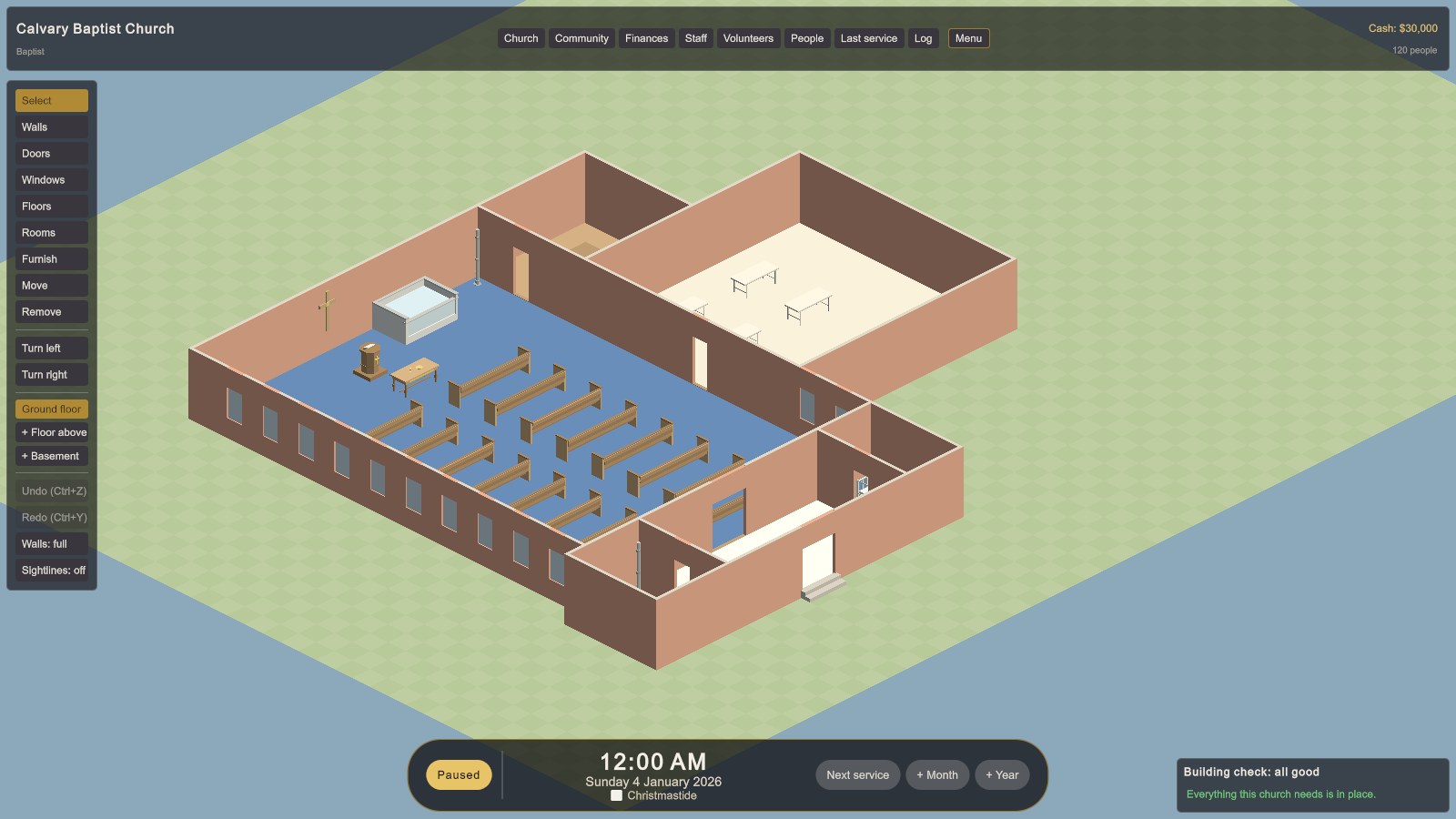
The building systems
The building is a set of systems, each with a condition from 1 (new) to 0 (worn out). The building's overall condition is what scenarios measure, and what people feel.
| System | Covers | Lasts | Replacing it costs |
|---|---|---|---|
| Roof | Slates, flashing, and gutters. "A leaking roof ruins everything under it." | 30 years | $120 per m² |
| Boiler and heating | The boiler, pipes, and radiators. "It always seems to die in January." Fails mostly in the heating season. | 25 years | $8,000 + $20 per m³ |
| Plumbing | Water and drains. | 40 years | $40 per m² |
| Electrical | Wiring, panels, and lights. | 35 years | $35 per m² |
| Pipe organ | Leather, wind, and thousands of pipes. Only if you have a Pipe organ. | 40 years | 30% of the organ's price |
| Furnishings | Pews, chairs, tables, and cabinets: scuffed, wobbly, and eventually beyond repair. | 30 years | 60% of the seating and furniture's price |
Wear
- Each system's condition falls by 1 ÷ (lifespan × 12) a month: a 30-year roof loses about 0.28% a month.
- Every hour a ministry or tenant uses the building each month, beyond Sunday, wears it 0.5% faster. A preschool's 40 hours a week makes the building wear a fifth faster.
- A sexton slows wear by up to half.
Failures
Each month, each system has a chance of failing:
chance = 0.001 + 0.1 × (1 − condition)³
| Condition | Chance of failing each month |
|---|---|
| 1.0 | 0.1% |
| 0.7 | 0.37% |
| 0.5 | 1.35% |
| 0.35 | 2.8% |
| 0.2 | 5.2% |
A failure is an emergency repair costing 10 to 50% of the system's replacement cost, and it doesn't renew the system: it's still just as worn afterwards. The boiler's risk rises in the heating season.
Maintenance
The maintenance budget (Finances → Budget, in steps of $100 a month) goes wherever it's most needed and restores condition at the replacement-cost rate. Small, steady budgets are far cheaper than failures:
A small church on $200 a month stays at full condition. Left alone for 20 years, the same church pays about $68,000 in emergency repairs and ends at 0.11.
Replacing a system
The Budget tab lists every system with its condition, its risk of failing next month, and a Replace button with the price. Replacing renews it to full condition. Replace a system when its risk passes about 3 to 4% a month and you can afford it, paying from a capital campaign's fund first (a repairs campaign is popular, at 0.8). The Overview warns you once any system reaches 4%.
What a worn building costs you
- Below 0.5 overall, the building costs everyone up to 0.2 satisfaction after every service.
- Below 0.35, tenants start to give notice (a one-in-four chance a month).
- In the dying parish, condition below 0.2 condemns the building and loses the game.
A maintenance plan
- Set a maintenance budget on day one: $200 to $300 a month for a small church, more for a large or Gothic one.
- Watch the system risks on the Budget tab every few months.
- When a system's risk passes 3%, run a repairs campaign and replace it.
- Hire a sexton once the building is big or busy with ministries.
- Don't let a repair push you into overdraft: take a loan instead.