Chapter 14
Scenario walkthroughs
Each scenario hands you a church in trouble or in transition, with goals to reach and failures to avoid. These walkthroughs follow the plans the game's own scripted player, "the steward", uses to win: a sensible pastor with no cleverness. You should do better.
How scenarios work
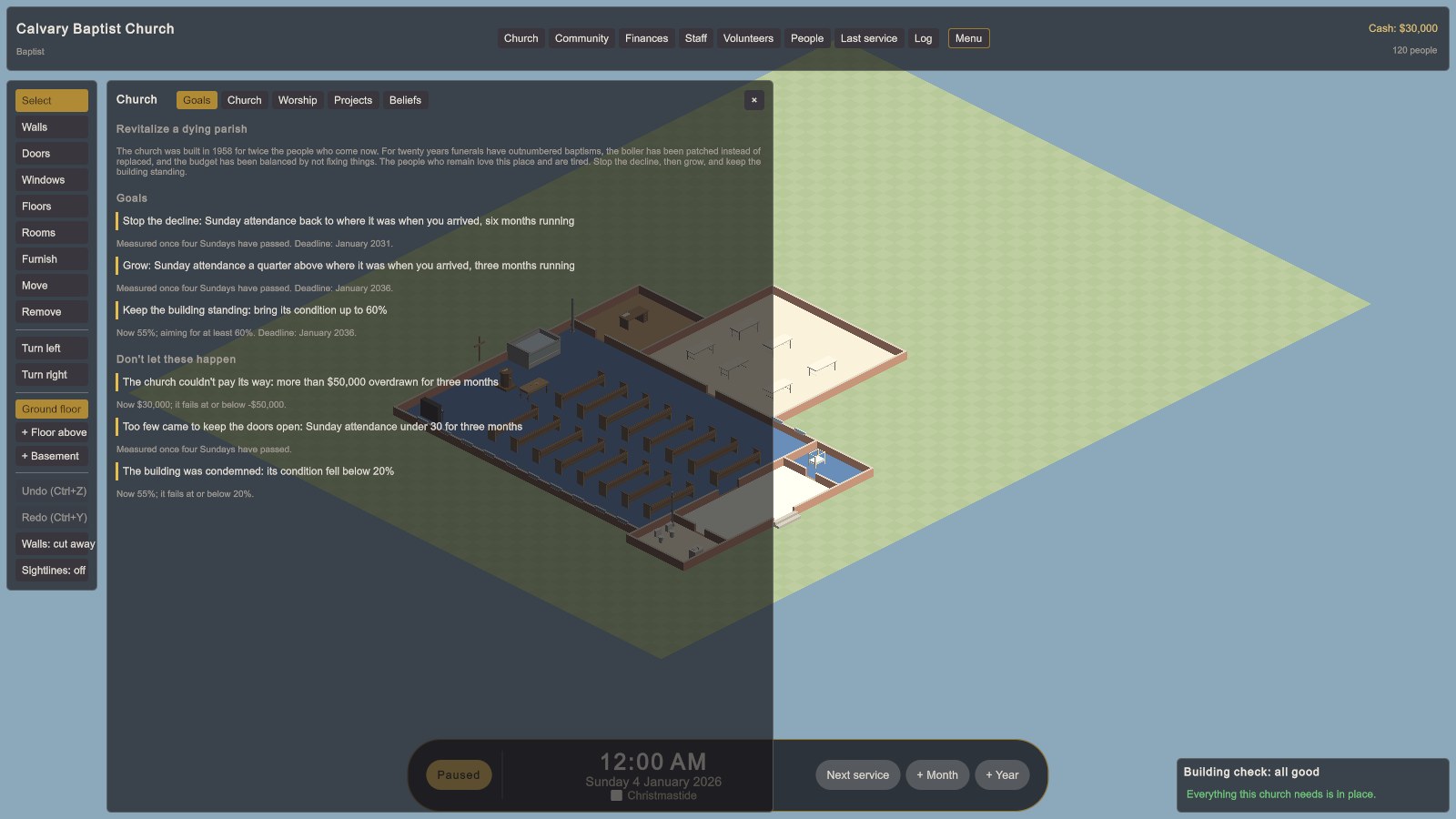
- Church → Goals shows the briefing, each goal with its deadline and where you stand, and the failures to avoid.
- Goals and failures are checked once a month, an hour after the monthly business. Many must hold for several months in a row.
- A goal is achieved once it holds for its months. It's missed if its deadline passes first, and a missed goal loses the game.
- A failure ends the game once it holds for its months. Some scenarios give you a few months' grace at the start.
- When every goal is achieved, you've won. After a win or a loss, the game carries on, but nothing more is checked.
Revitalize a dying parish
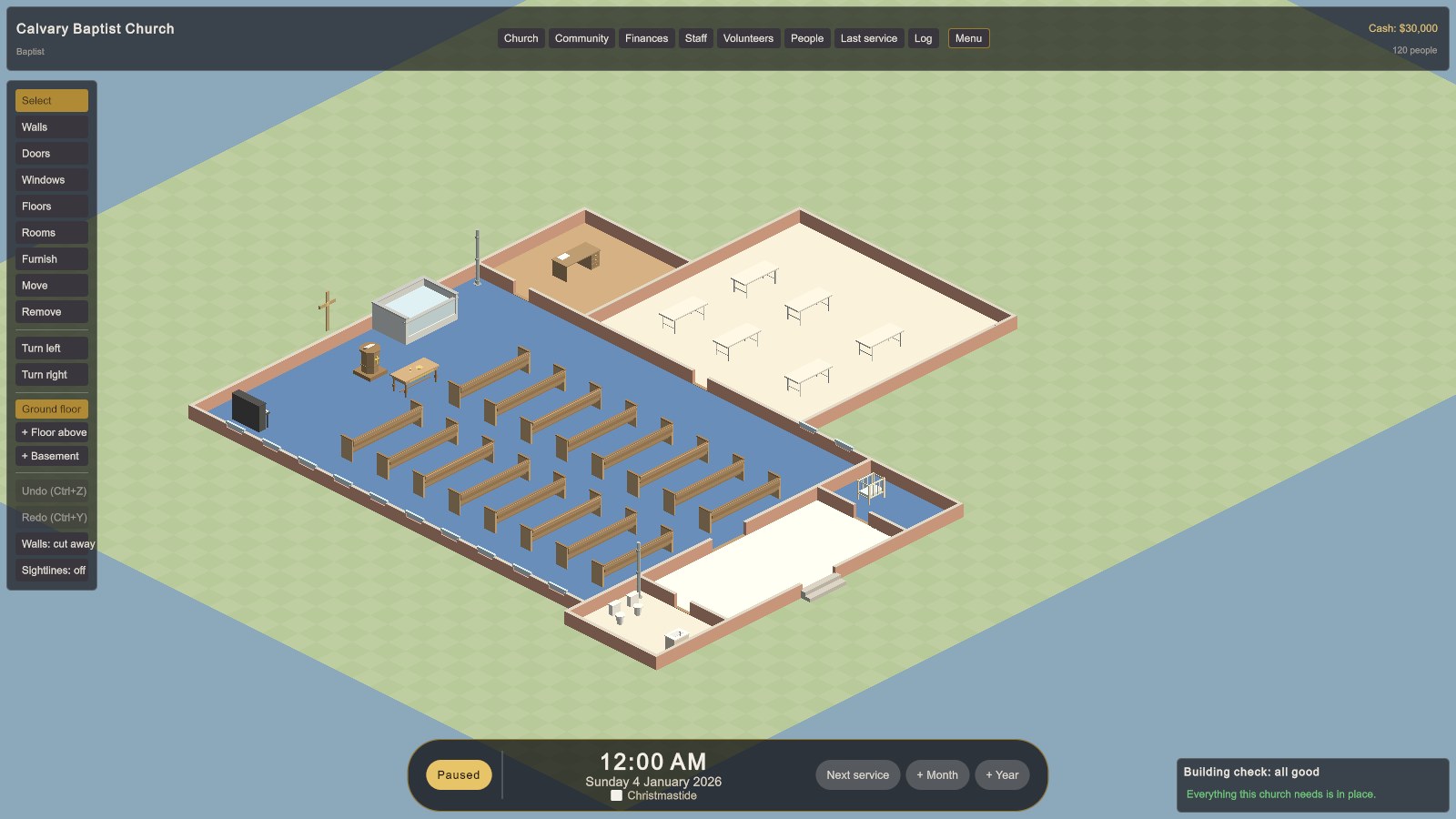
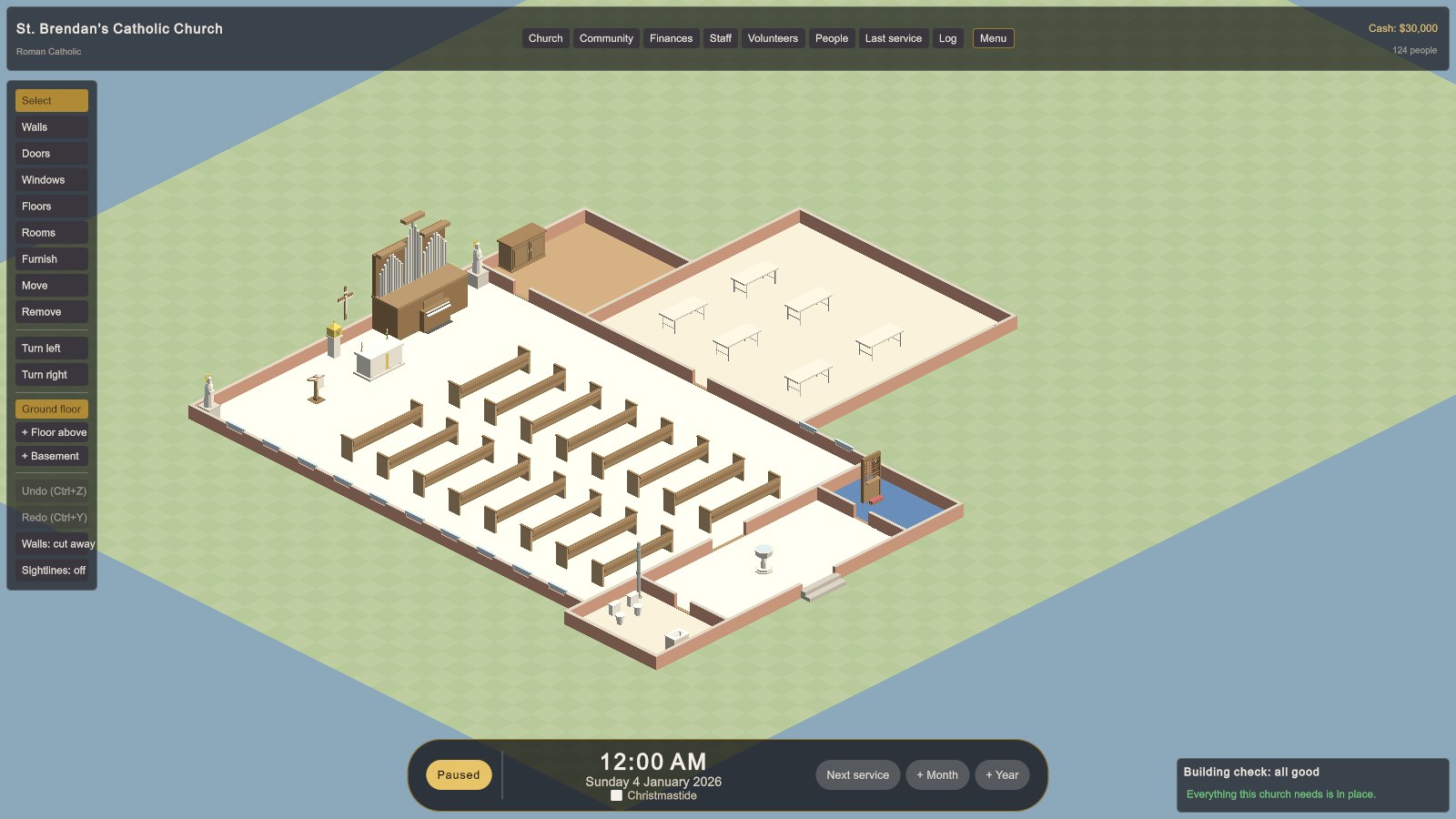
"The church was built in 1958 for twice the people who come now. For twenty years funerals have outnumbered baptisms, the boiler has been patched instead of replaced, and the budget has been balanced by not fixing things. The people who remain love this place and are tired."
| You start with | About 120 people, mostly over 55, satisfaction between 0.37 and 0.67. $30,000 cash and a $250,000 endowment. A full-time pastor (you) and no other staff. Every building system at 0.55, and no maintenance budget. 128 seats, steps at the front doors, no hearing loop. Baptists give more per adult ($3,900 against $3,100). |
|---|---|
| To win | Sunday attendance back to where it started, six months running, within five years. Attendance a quarter above where it started, three months running, within ten years. Building condition up to 60% for three months. |
| You lose if | More than $50,000 overdrawn for three months; under 30 on Sunday for three months; condition below 20%. |
Walkthrough
- Stop the bleeding (month 1). Draw 5% from the endowment. Set a maintenance budget. Recruit greeters, ushers, a nursery team, and a choir. Left alone, the pastor's salary and the ageing building outrun giving: the untouched parish loses every time.
- Fix access (year 1). A Ramp at the stepped front doors, and a Hearing loop. This congregation is old, and both cost it something every week until fixed.
- Repair the building (years 1 to 3). Run a two-year repairs campaign while the building is poor, and replace any system whose monthly risk passes 3%. Get condition to 0.6 for three months to tick off that goal.
- Then grow (years 2 to 5). With money steadier, hire a choir director / organist once you average a $2,500 monthly surplus. Make sure every visitor is greeted. The church was built for twice as many, so you have seats.
- Catholic only: pay the diocesan assessment. If money is tight, pay half in the worst months; don't stop.
Don't rip out pews to modernize. This congregation has been here for decades, and long-standing members oppose it most (see Projects, approvals and conflict).
The steward's record: it wins nearly every run in both traditions. Doing nothing never wins.
Plant in a new suburb
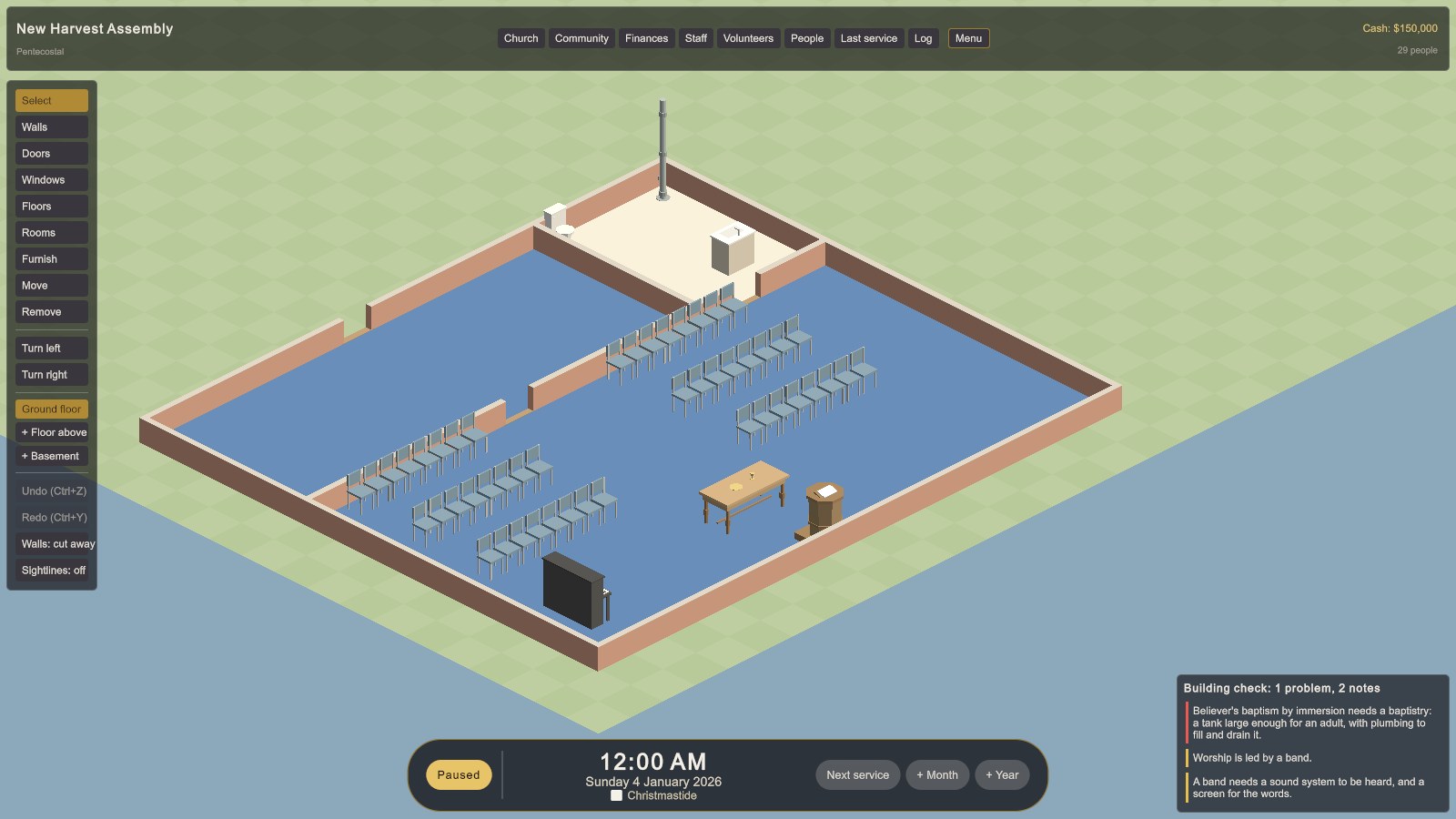
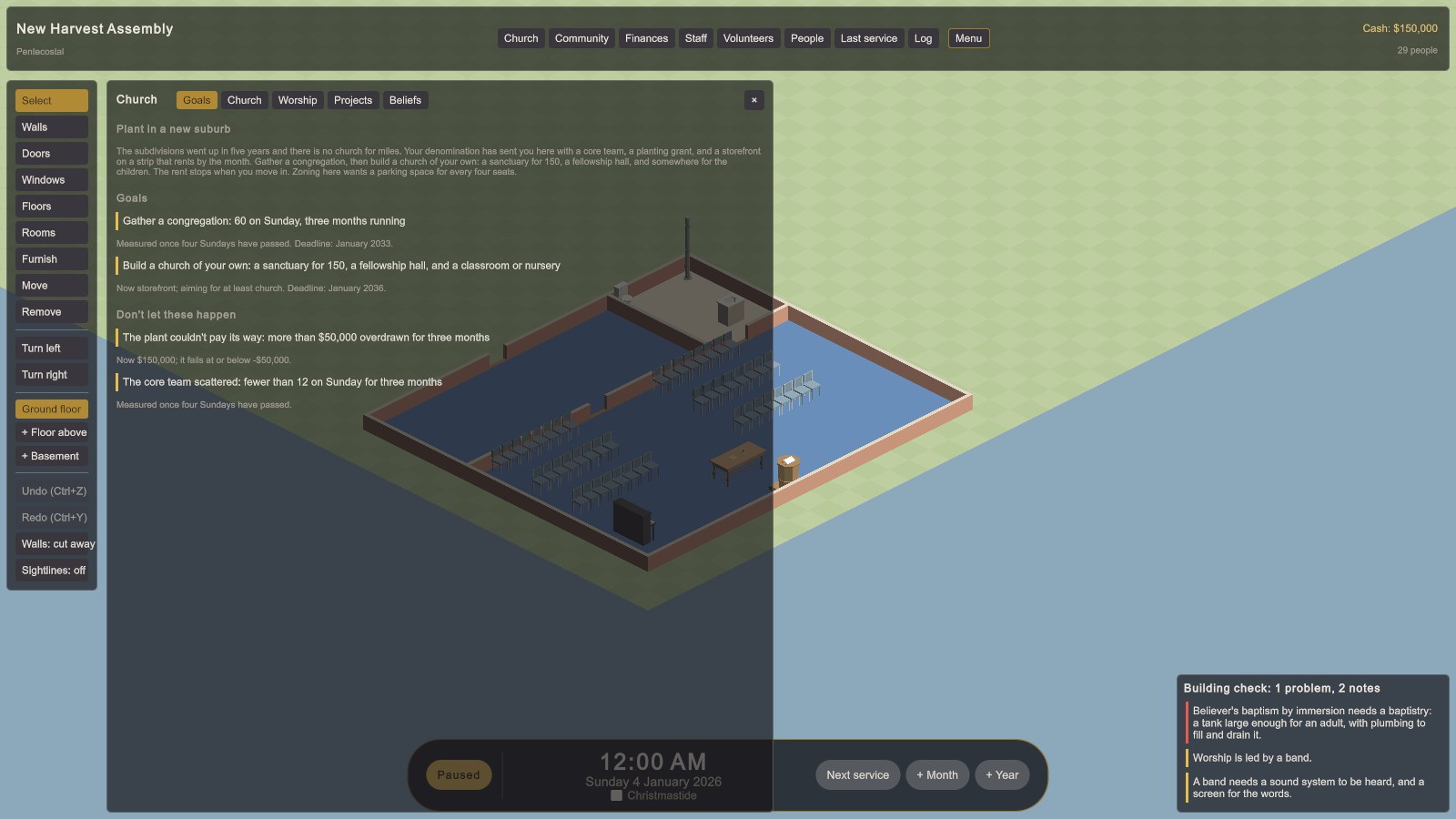
"The subdivisions went up in five years and there is no church for miles. Your denomination has sent you here with a core team, a planting grant, and a storefront on a strip that rents by the month."
| You start with | A core team of about 25 in a rented storefront on a suburban lot. A bivocational pastor. $150,000, and a planting grant of $4,000 a month for four years. Rent of $2,500 a month until the church has a building of its own. Twice the usual newcomers: the suburb is new and filling up. |
|---|---|
| To win | 60 on Sunday within seven years. A church of its own, the Church growth stage (150 seats, a fellowship hall, and a classroom or nursery), within ten. |
| You lose if | $50,000 overdrawn for three months; fewer than 12 on Sunday for three months. |
Walkthrough
- Fit out the storefront with what your tradition requires: a Baptistry with a Plumbing stack for Baptists and Pentecostals, plus a Drum kit and Sound system for Pentecostals. The newcomers are there; welcome them.
- Gather people first. Greeters from day one, a nursery, and a restroom.
- Plan the move before the grant ends (month 48). Run an expansion campaign (the most popular cause), take a building loan, and build a sanctuary of about 150 seats beside the storefront, with a nursery or classroom.
- Turn the storefront into the fellowship hall. Reaching the Church stage ends the lease, and with it the rent.
- Keep the overdraft away. The plant runs close to the line. Take the loan before you need it.
The steward's record: 60% of runs as Baptists, every run as Pentecostals. Pentecostal worship is cheaper to furnish and owes no apportionment.
Restore a fire-damaged historic church
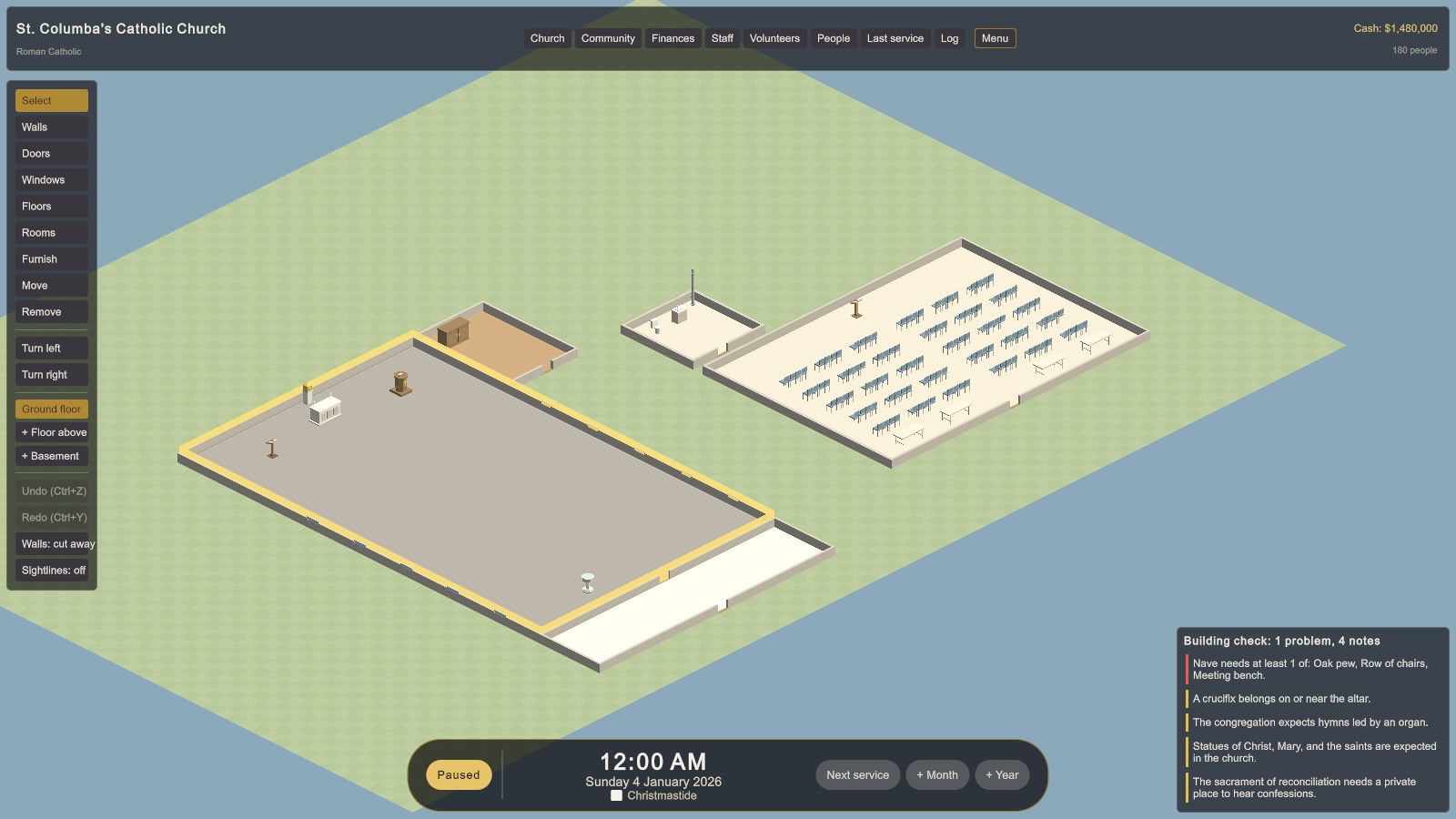
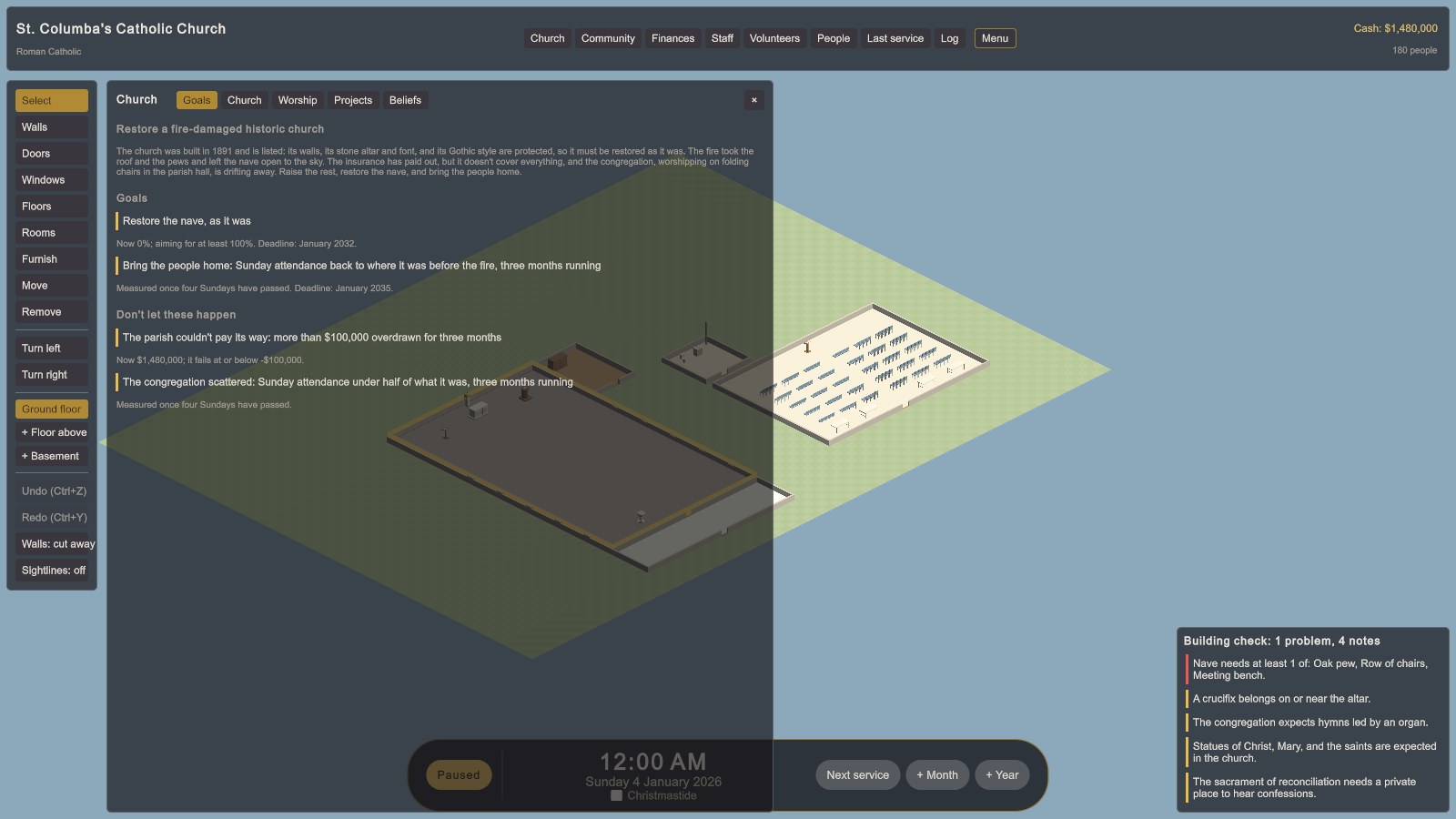
"The church was built in 1891 and is listed: its walls, its stone altar and font, and its Gothic style are protected, so it must be restored as it was. The fire took the roof and the pews and left the nave open to the sky."
| You start with | About 180 people worshipping on folding chairs in the hall. $1.4 million of insurance, paid at the start. Restoring the nave costs $1.6 million and a year's work. The walls, altar, font, and style are protected: they can't come down, be taken out, or change. |
|---|---|
| To win | Restore the nave within six years. Then bring Sunday attendance back to where it was before the fire, three months running, within nine. |
| You lose if | $100,000 overdrawn for three months; attendance under half for three months. |
Walkthrough
- Close the gap. Insurance covers most of it. A restoration loan and a repairs campaign cover the rest. Lean on the endowment while cash is low.
- Propose the restoration with the Restore button on Church → Church (it shows the price and who must approve it) as soon as the parish can carry it. Members back restoring their own church readily; a bishop wants it affordable.
- Keep the hall welcoming meanwhile. It's where visitors meet you for a year or more: greeters, a nursery, a restroom.
- Put the furnishings back when the nave is done: pews and the tradition's furniture. The building check lists what's missing.
- Don't fight the listing. Build around the protected walls and pieces.
The steward's record: every run as Catholics, 95% as Lutherans.
Build a cathedral across generations
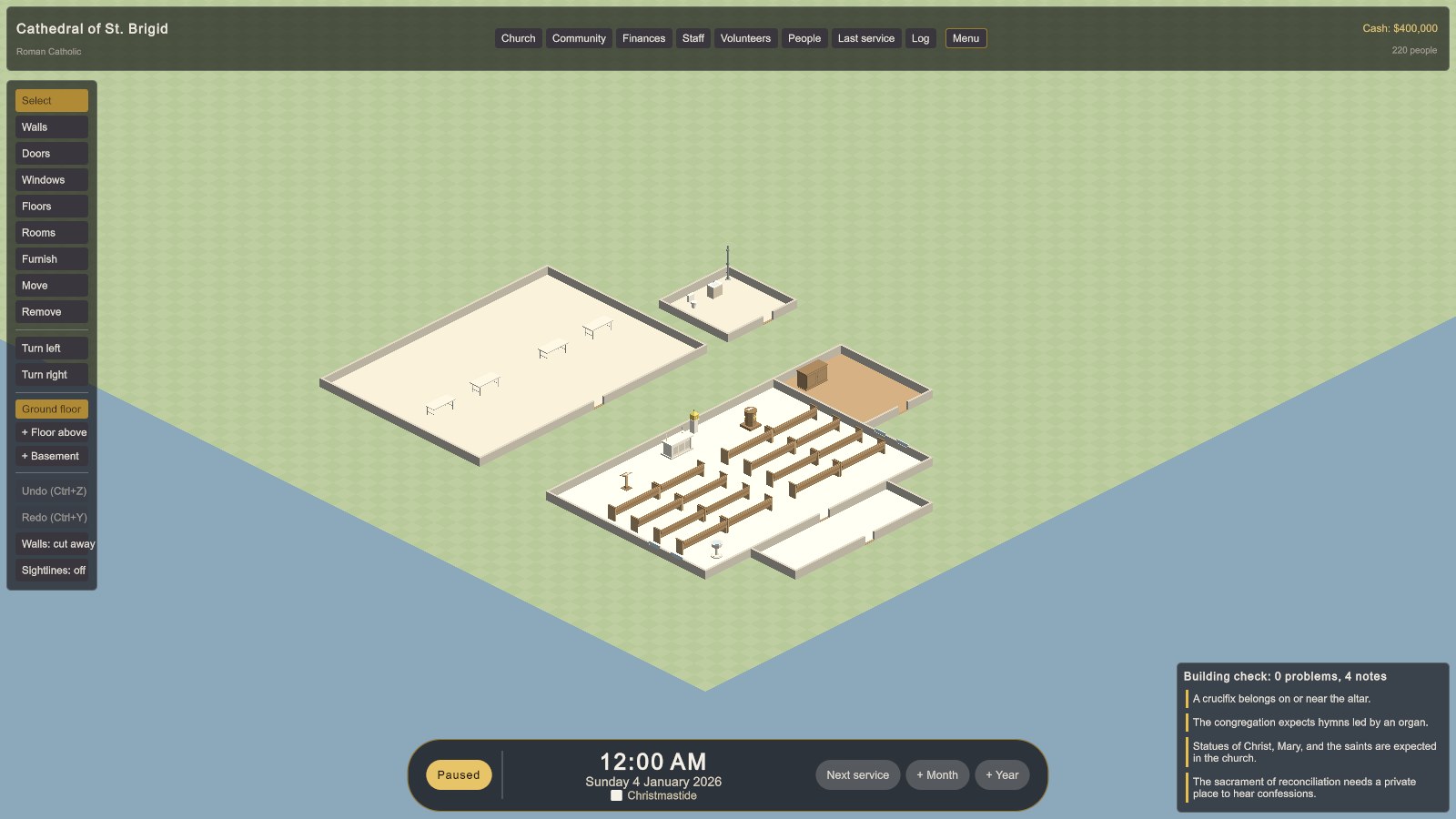
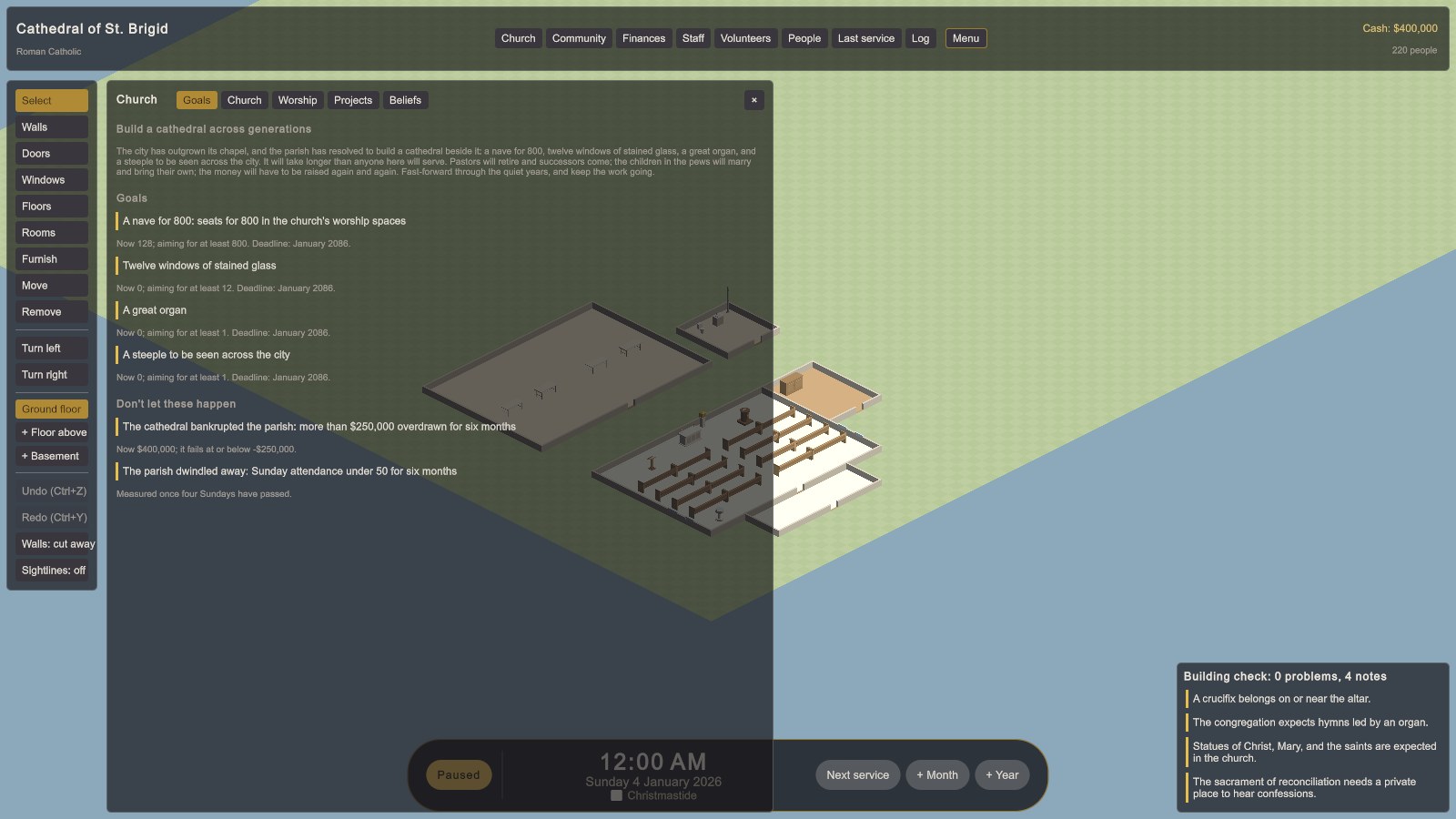
"It will take longer than anyone here will serve. Pastors will retire and successors come; the children in the pews will marry and bring their own; the money will have to be raised again and again."
| You start with | A Gothic chapel for 160, room for a nave forty metres by sixty, $400,000, and a $4 million foundation. A growing city: 1.5 times the usual newcomers. Sixty years. |
|---|---|
| To win | Seats for 800, twelve stained-glass windows, a Pipe organ, and a Steeple and bells. |
| You lose if | $250,000 overdrawn for six months; fewer than 50 on Sunday for six months. |
Walkthrough
- Keep a building campaign going the whole time. It's how a parish this size funds stone.
- Raise the nave's walls when cash and the campaign cover them. Don't lay the whole floor at once: an unfloored shell costs nothing to heat, so floor it in sections as you can use them.
- Add pews as the floor goes in, then a window of stained glass every six months, then the organ (30 months to build), then the steeple.
- Lean on the foundation once the nave stands, at a sustainable rate.
- Ask only for what the bishop will grant, and ask again for what was turned down once you can afford it.
- Use + Year on the time bar. Decades pass event by event: pastors retire and are replaced, generations are born, marry, and grow up.
The steward's record: 85% of runs as Catholics and every run as Lutherans, in fifteen to twenty years.
Long games: what changes over decades
- Fast-forwarding (+ Month, + Year) moves event by event instead of minute by minute. Services are still held and felt, but at once: everyone who's coming sits (or stands) as the service is decided, communion takes no time, and nobody is late.
- Clergy succession. After ten years a pastor may be called elsewhere; after 25 they retire. A bishop appoints a successor within two months; elsewhere a search takes nine.
- Generations. Couples of 22 to 40 have children. Grown children leave home at a fifth a year, half to a household of their own in the church and half away. People who have drifted away for good are forgotten each January.