Chapter 13
Traditions, beliefs and stances
Your tradition decides what the building needs, who approves your projects, how worship runs, and what the congregation expects. This chapter profiles all six shipped traditions, then covers standing with the denomination, social stances, changing practice, schism, and founding a tradition of your own.
The six traditions at a glance
| Baptist | Catholic | Lutheran (ELCA) | Pentecostal | Orthodox | Quaker | |
|---|---|---|---|---|---|---|
| Service | Preaching service | Mass | Divine Service | Praise and worship | Divine Liturgy | Meeting for worship |
| Renovations decided by | Members' vote | The priest | Church council | Members' vote | The priest | The meeting, by consensus |
| New construction | Members' vote | The bishop | Members' vote | Members' vote | The bishop | Consensus |
| Apportionment | 5% (voluntary) | 10% | 7% | none | none | none |
| Communion | Monthly | Weekly | Weekly | Monthly | Weekly | none |
| Formality | Low (0.33) | High (1.0) | Moderate (0.67) | Minimal (0) | High (1.0) | Minimal (0) |
| People lean | Conservative | Neutral | Liberal | Conservative | Conservative | Liberal |
| Music wanted | Piano | Organ | Organ and choir | Band | Choir, no instruments | None |
| Room sound | Neutral | Somewhat live | Live | Dry | Live | Neutral |
| Best style | Brick | Gothic | Either | Brick | Gothic | Brick |
Baptist
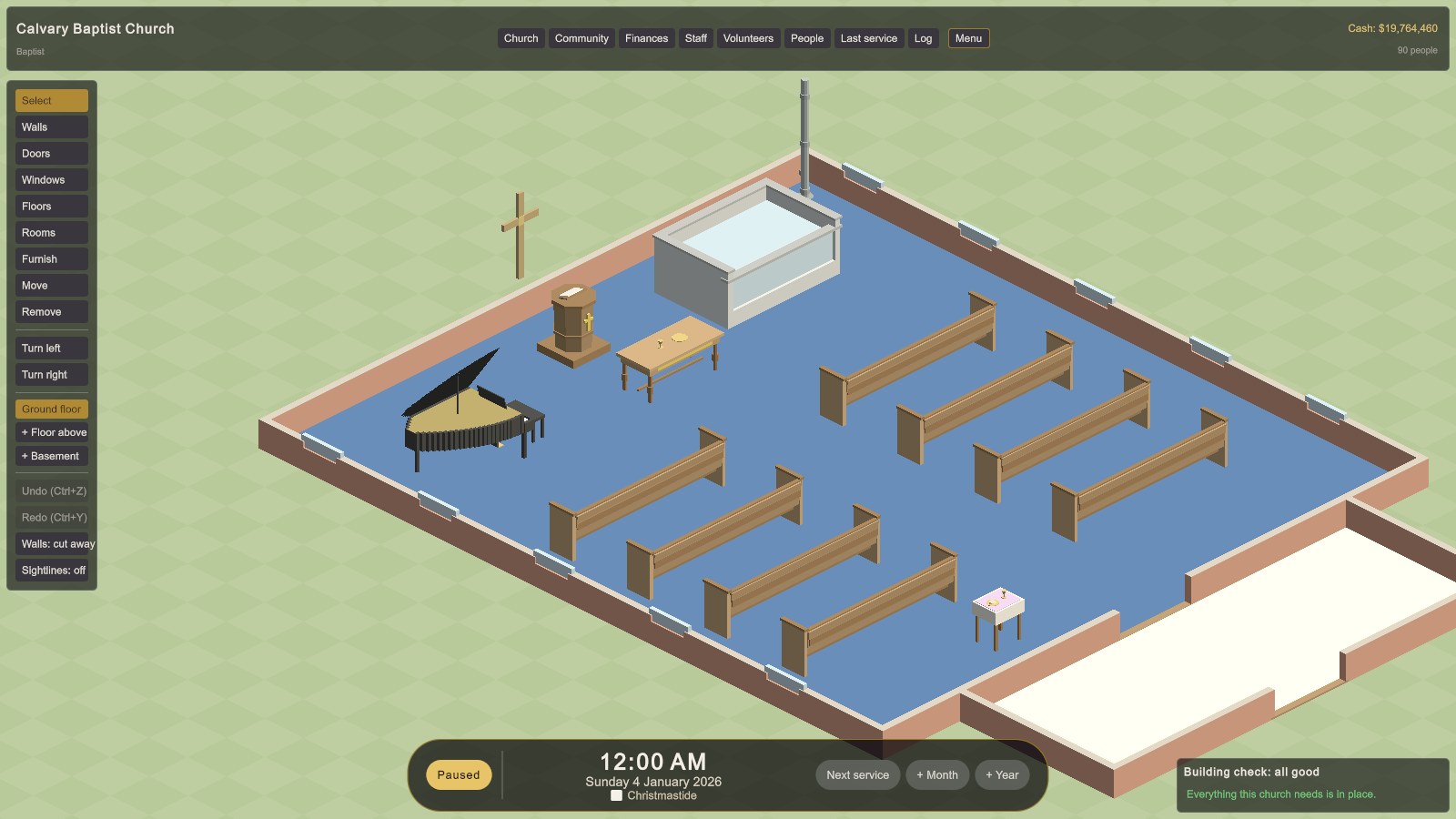
A free-church tradition: congregations govern themselves, baptize believers by immersion, and keep the Lord's Supper monthly as a memorial. Worship centres on the sermon.
- Required: Pulpit, Communion table, Baptistry (with a Plumbing stack within 12 m).
- Expected: Upright piano (or a Grand piano), Communion trays.
- Discouraged: statues, icons, a Crucifix.
- Fits best: pianos (+1), chairs (+0.33), drum kit and sound system (+0.17).
The members decide almost everything, so keep them happy before any big proposal. Apportionment (the Cooperative Program) is voluntary: paying less hurts only your standing, and nothing turns on standing for a Baptist church's own projects.
Roman Catholic
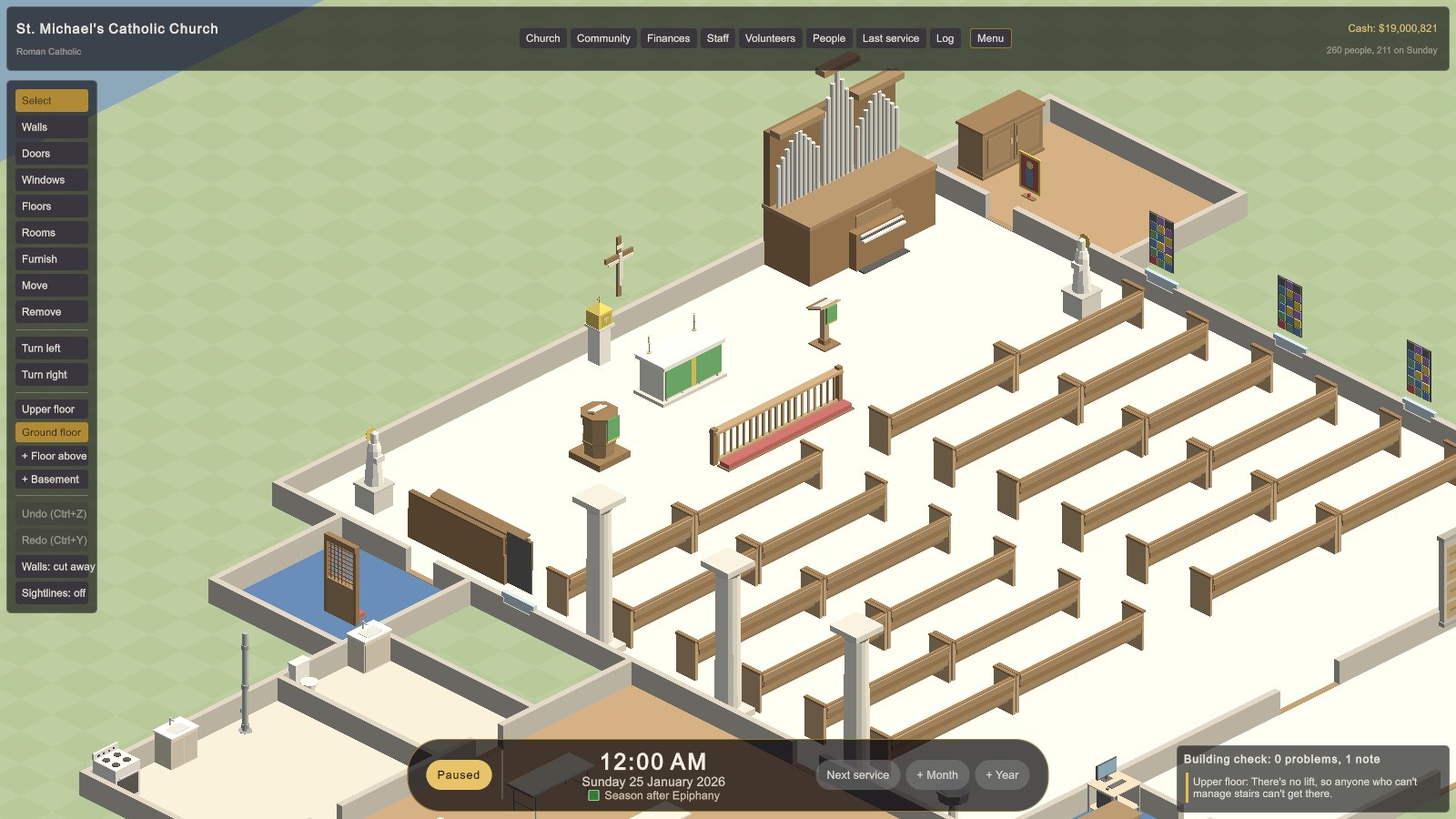
Real presence in the Eucharist, celebrated every Sunday at the altar; infant baptism by pouring; a formal, sacramental liturgy; parishes under a bishop.
- Required: Altar, Baptismal font, Tabernacle, a sacristy.
- Expected: an organ (pipe or electronic), statues, a Crucifix, a Lectern, a reconciliation room.
- Fits best: almost every formal item scores +1: altar, rail, font, tabernacle, organ, statues, stained glass, pillars, the steeple. Chairs score −1.
The priest decides renovations at once; the bishop decides new construction, and wants the parish solvent and in good standing, so pay the 10%. Changes made on authority provoke harsher reactions (see Projects, approvals and conflict). Gothic suits a Catholic church almost perfectly.
Lutheran (ELCA)
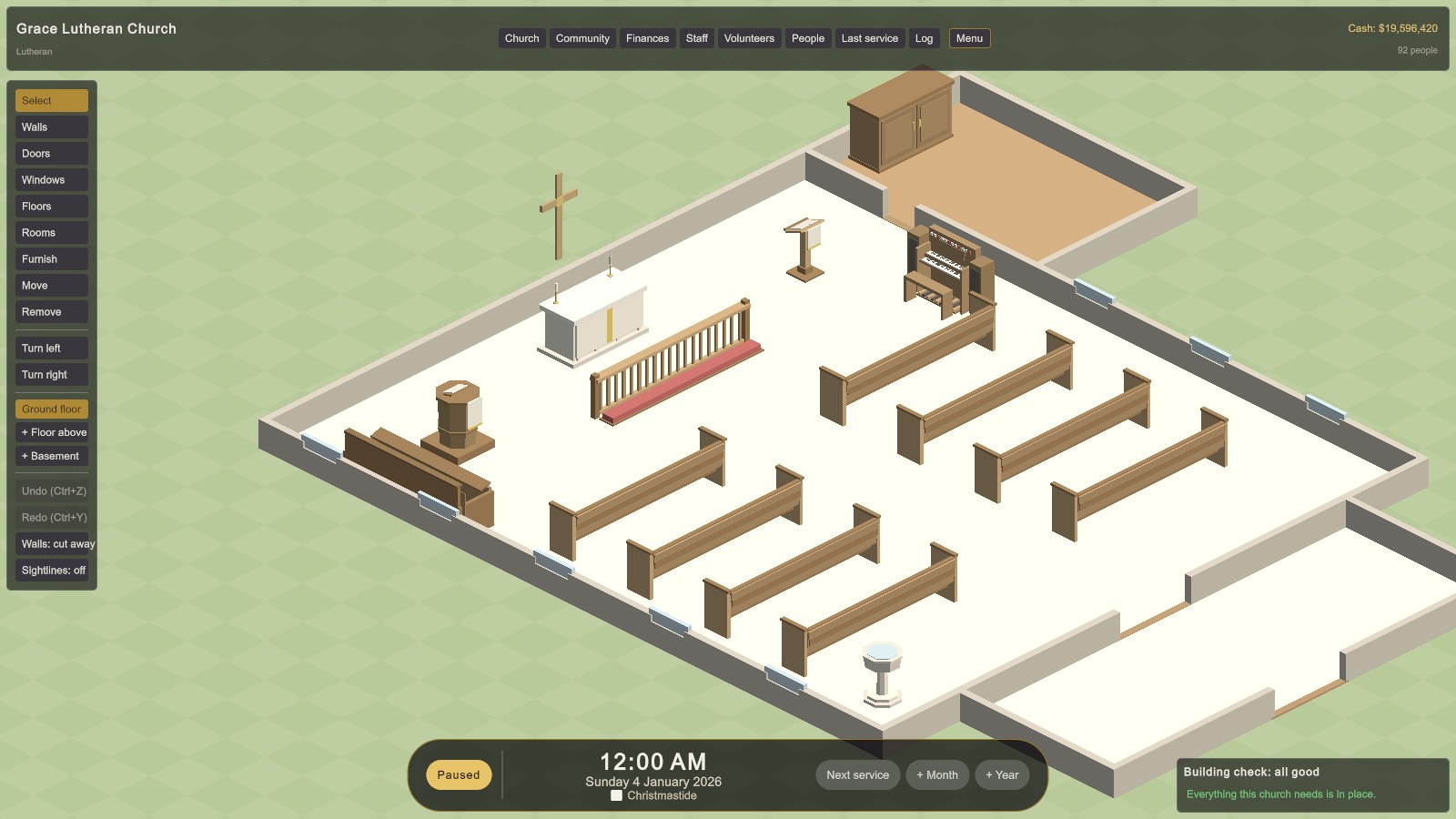
Word and sacrament in balance: a pulpit beside the altar, weekly communion received at the rail, infant baptism, and a strong tradition of organ and choir.
- Required: Altar, Pulpit, Baptismal font, Communion rail, a sacristy.
- Expected: an organ, Choir stalls, a Lectern.
- Fits best: electronic organ (+1), choir stalls and pipe organ (+0.67), formal items (+0.33). Chairs −0.33.
The church council votes on renovations; the members on new building. Lutherans want the most reverberant room of any tradition, so stone floors and Gothic walls pay off.
Pentecostal (Assemblies of God)
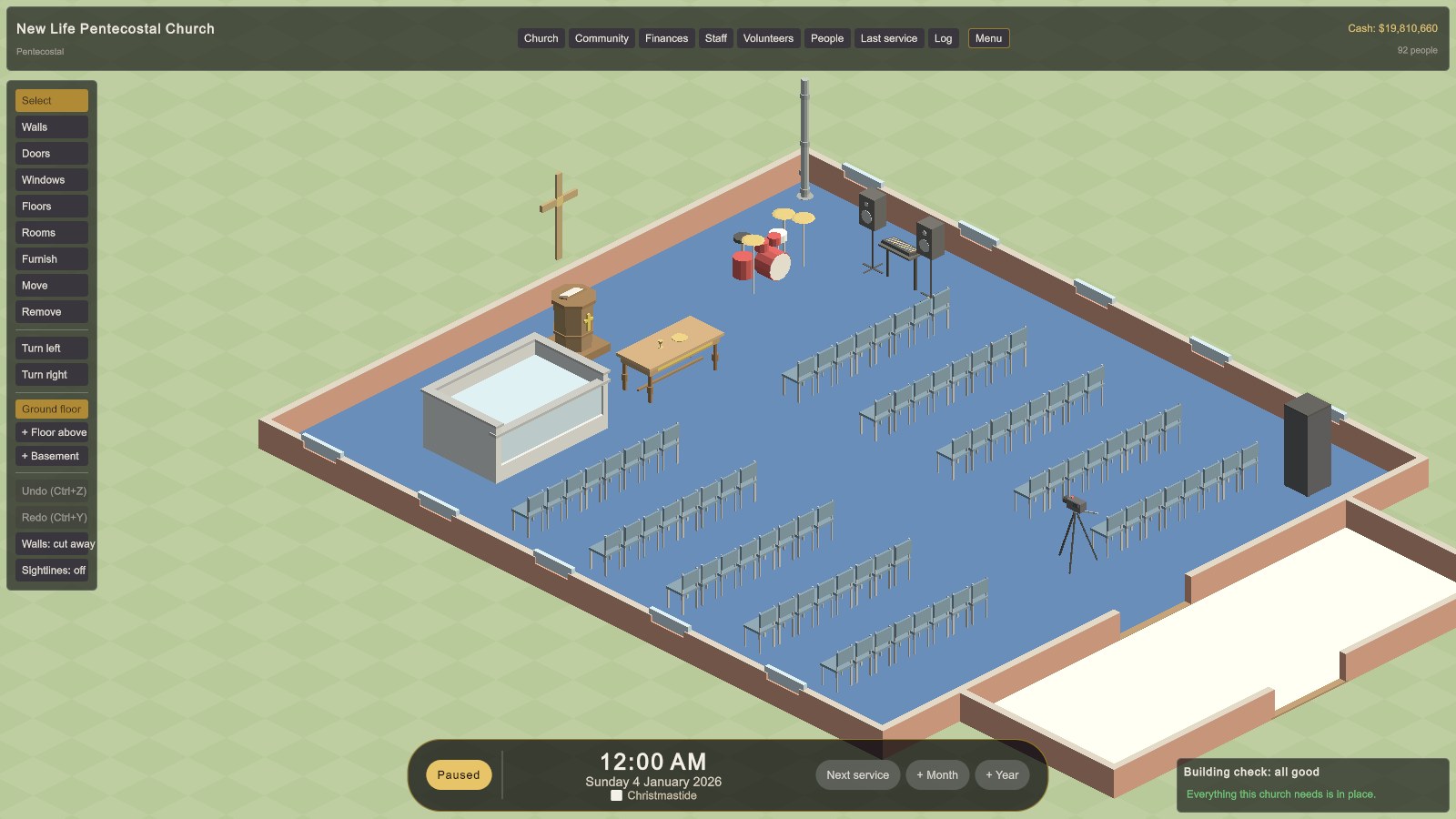
Long, band-led praise and worship, a long sermon, and an altar call; believers' baptism by immersion; the Lord's Supper monthly.
- Required: Pulpit, Communion table, Baptistry.
- Expected: Drum kit, Sound system, Communion trays.
- Discouraged: statues, icons, a crucifix.
- Fits best: chairs, drum kit, and sound system (+1). Every formal item scores −1.
The cheapest tradition to furnish and to run, with no apportionment. Pentecostals want a dry room: carpet, and no Gothic stone. Watch the neighbours: drums and a sound system are noisy.
Eastern Orthodox
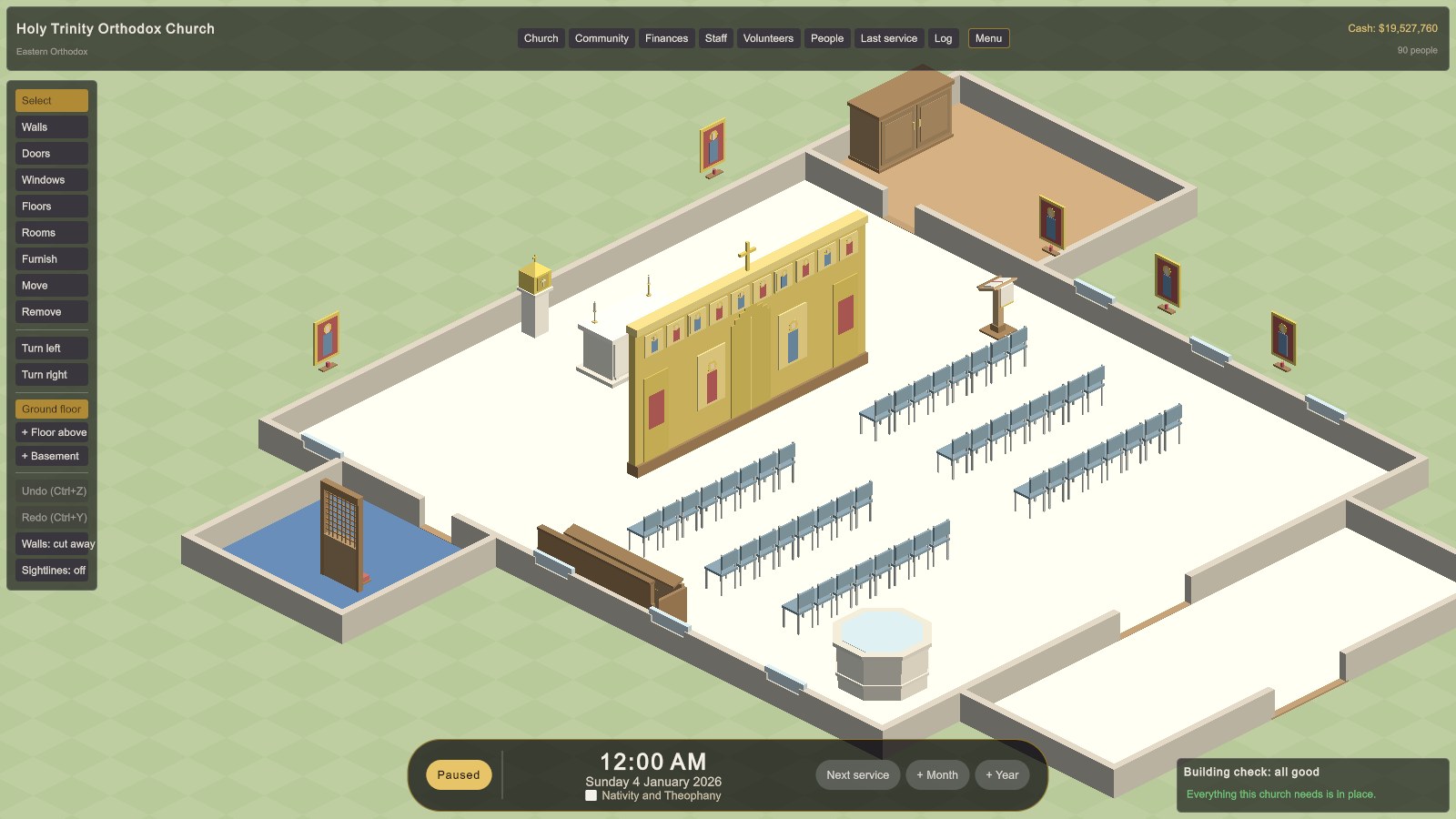
The Byzantine Divine Liturgy, sung throughout; the iconostasis between nave and sanctuary; infant baptism by full immersion; weekly communion; the Eastern church year.
- Required: Altar, Iconostasis, Immersion font, Tabernacle, a sacristy.
- Expected: icons, Choir stalls, a Lectern, a reconciliation room, and the church facing east.
- Discouraged: Oak pew, organs, pianos, drums, statues.
- Fits best: icons, the iconostasis, choir stalls, and every formal item (+1). Chairs, instruments, and statues −1.
Pews are discouraged (−0.03), but standing costs far more (−0.15), and chairs score −1 for fit. The best compromise is a few rows of chairs in a nave full of icons and formal furniture, so the chairs are a small part of the average. Turn the lot in Church → Church so the church faces east.
Quaker (unprogrammed)
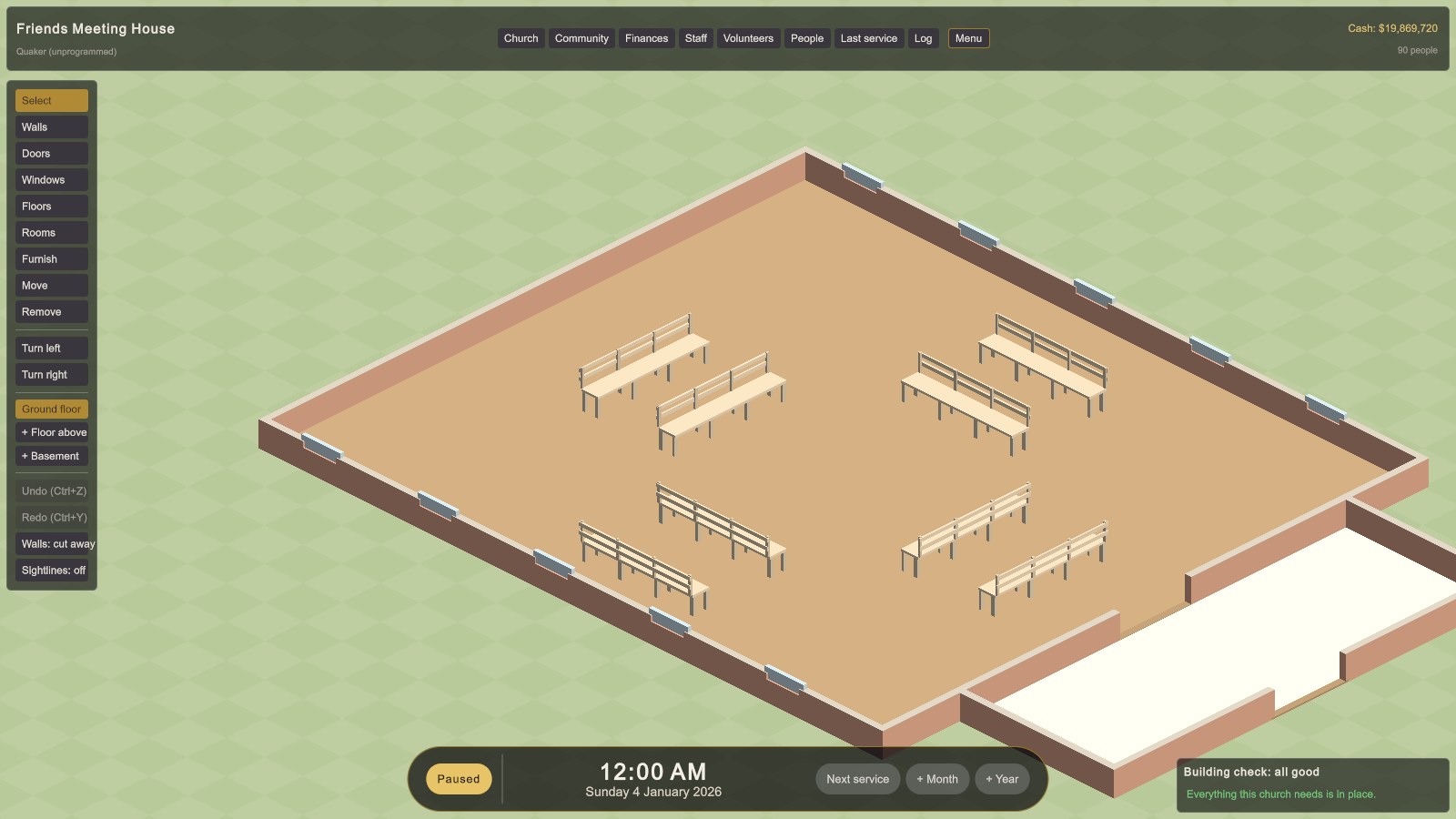
Friends gather in silence, facing one another, with no one appointed to lead. Anyone moved to speak rises and does so where they sit. No sacraments are observed outwardly, and there's no church year.
- Required: nothing beyond a narthex and a nave.
- Expected: meeting benches.
- Discouraged: a pulpit, organ, piano, drums, choir stalls, crosses, statues, icons.
- Fits best: chairs (+1). Every formal or religious item −1.
No pastor needed (no preaching factor, and no penalty for its absence), no apportionment, almost nothing required. But decisions need consensus: no more than a tenth may object. Propose only what nearly everyone wants.
Standing with the denomination
The denomination's regard for your church runs from 0 to 1. Two things pull it down:
- Unpaid apportionment. Each month standing moves a fifth of the way toward 1 minus your arrears over a typical year's bill. A year of paying nothing to a Catholic diocese drops it to about 0.1. Paying more than 100% (up to double) clears arrears.
- Drift from the tradition (see changing practice, below).
Below 0.7 a bishop or presbytery won't approve your projects. Below 0.5 the denomination says it's troubled. Paying half the apportionment in a crisis month is a reasonable compromise; paying nothing for long is not.
Social stances
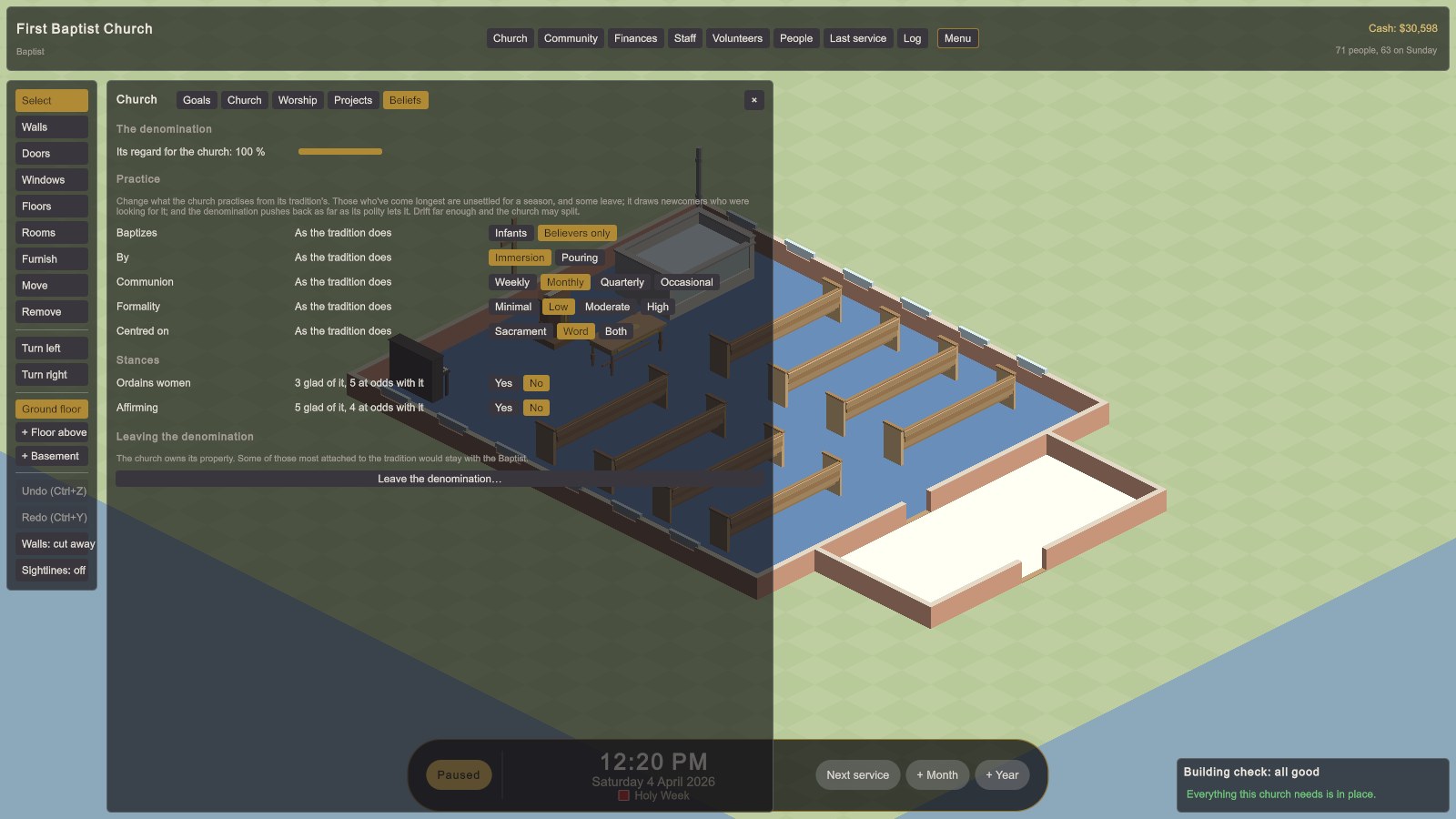
Where the denomination leaves it to the congregation (Baptists and Pentecostals, for instance), you choose on Church → Beliefs whether your church ordains women and whether it's affirming. Each person has a view. Those who hold a strong view (beyond 0.4 from the middle) feel the church's practice after every service: up to −0.2 if at odds, +0.06 if in accord. Visiting households at odds come back less than half as often and never join.
The Beliefs tab shows how many of your people are glad and how many are at odds with each choice. The game takes no side. Each choice shapes who joins you over the years, and the wider community newcomers come from is evenly split. Changing a stance mid-game unsettles nobody beyond what the views themselves feel, so it's easier to change than practice.
Changing practice
On Church → Beliefs you can change the church's practice from its tradition's: who is baptized and how, how often communion is celebrated, how formal worship is, and what it centres on. Each change has a size: who is baptized 1, how 0.4, each step of communion frequency 0.2, of formality 0.25, a change of focus 0.3 or 0.6.
- The building follows. A Baptist church that starts baptizing infants (still by immersion) needs an Immersion font; the building check updates at once.
- Long-standing members are unsettled for 13 weeks (−0.08 a week), more likely the longer they've come. When it settles, each unsettled household leaves with up to a 30% chance.
- It draws newcomers looking for just that: up to half as many again, for a year.
- The denomination pushes back. Standing falls toward 1 minus the distance drifted times 0.6 under a bishop, 0.45 under a presbytery, or 0.2 for congregational churches.
- Change your mind within the 13 weeks and nothing settles.
Practice changes are powerful but expensive. Make one big change, not many small ones, and make it when the congregation is young in tenure and the money is good. Episcopal churches pay a much higher price in standing.
Schism and leaving the denomination
Drift 1.5 or more from the tradition, and a change that settles with a third or more of the church still unsettled splits it: every unsettled household leaves together.
Or the church can leave its denomination (Church → Beliefs → Leave the denomination). It then governs itself, owes nothing, and decides its own stances. The cost is buying the building out of the denomination's trust: half its worth under a bishop, 30% under a presbytery, nothing for congregational churches. Some of those most attached to the tradition stay with the denomination.
Founding a tradition of your own
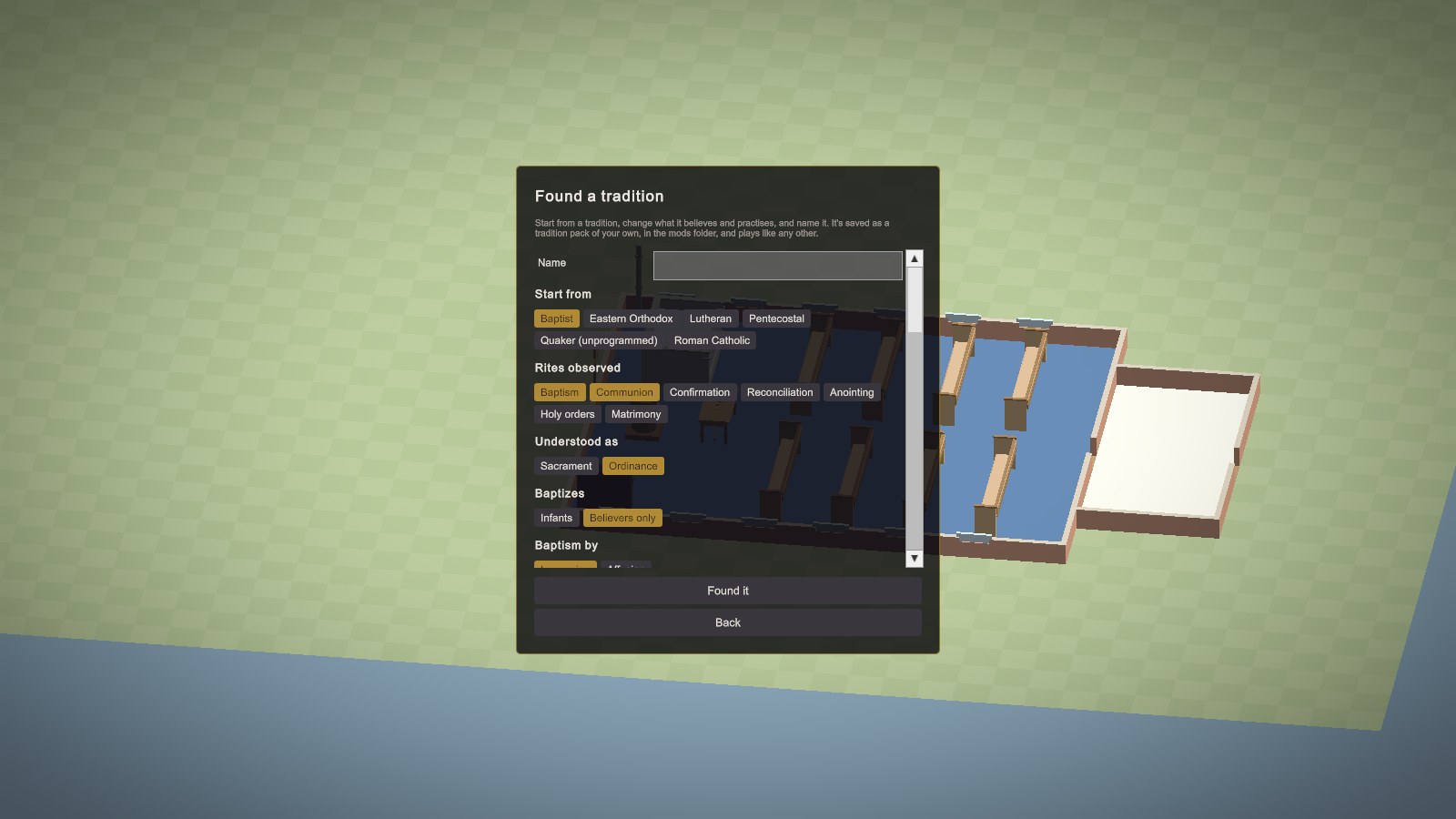
Mods → Found a tradition, or Found a tradition of your own… on the sandbox screen, lets you start from any tradition, change any of its attributes, name it, and found it. It's then chosen for a new sandbox game. The game checks it as it checks its own content: baptism and communion must be described if and only if they're observed, and nothing can be both wanted and forbidden.
Your tradition is saved as a tradition pack in the mods folder (in my-traditions/), in exactly the format of the game's own, so it's a good starting point for a pack to share. Founding one of the same name again replaces it.
Tradition packs
Communities can add their own traditions, and correct the details of others, with tradition packs: folders of content loaded from the mods folder. No programming is needed. The Mods screen shows where the folder is (with Open the folder and Reload), what's installed, and any problems in it. The game comes with a sample pack, a Methodist tradition, in its SampleMods folder: copy it into the mods folder to play it. A mod's item replaces the game's item with the same ID.