Chapter 11
Projects, approvals and conflict
You don't run the church alone. Big building work needs the approval of whoever your tradition says decides, and some changes, above all taking out cherished pews, start a fight. This chapter explains how decisions are made and how to get your way without losing people.
What needs approval
Once the church is open, building work of $25,000 or more in one go needs approval. Work of $25,000 or more is a renovation; work of $150,000 or more is new construction. A single item, however dear (an organ, a steeple), counts as a renovation.
A church that starts on an empty lot, as a sandbox does, needs no approval until it first passes the building check. Buying more land always does.
The building preview tells you before you commit, for example: "Needs the members' vote (in 4 weeks); paid for only if approved." Until it's decided, the work waits as a proposal, unpaid, and can be withdrawn. If by the time it's decided the work can't be done as proposed, it lapses.
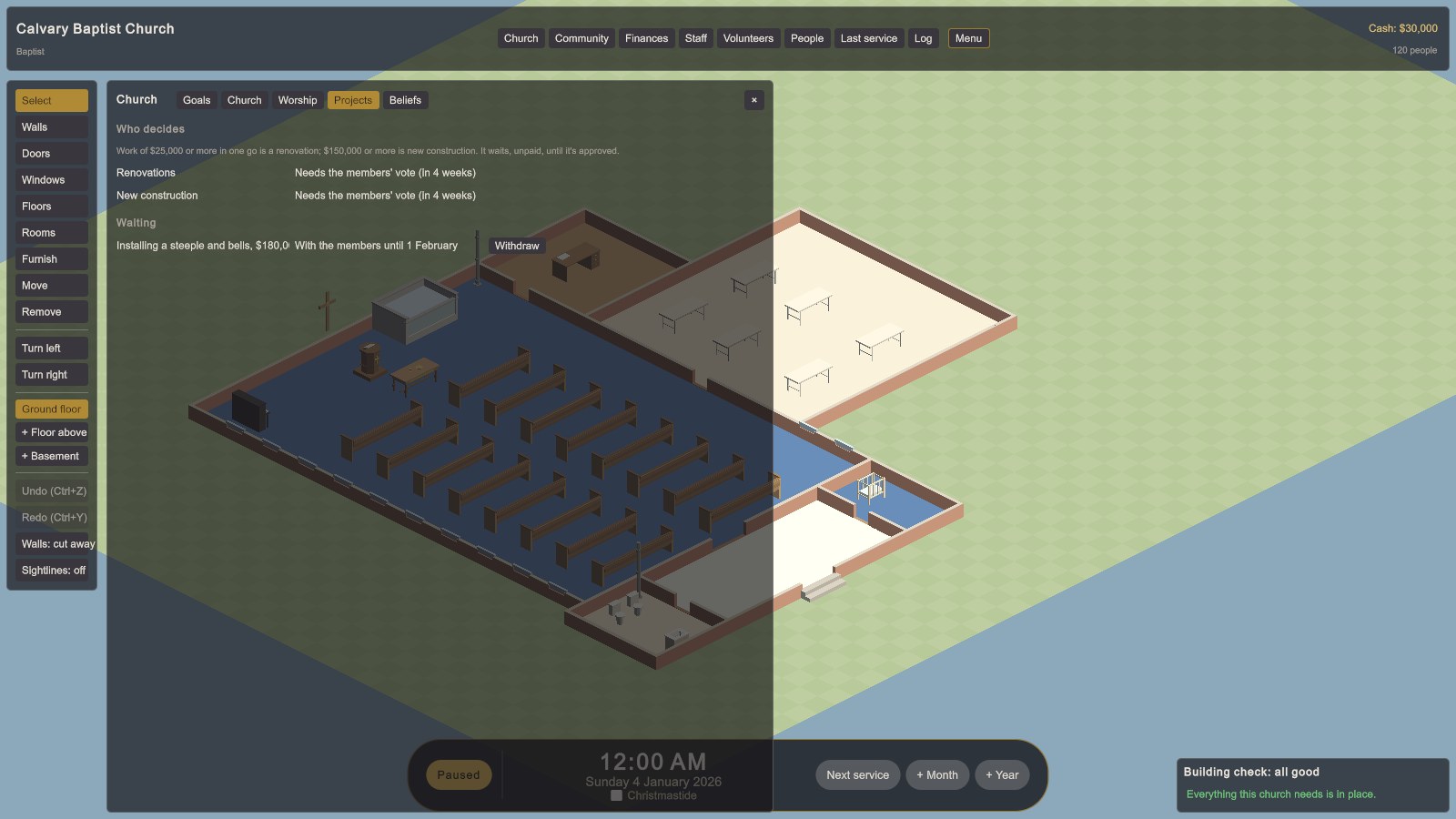
Who decides
| Who | How | When |
|---|---|---|
| The pastor or priest | Goes ahead at once | Now |
| The board (session, council, vestry) | The seven longest-serving members vote | Two weeks on |
| The members | Every member of 16 and over votes | Four weeks on |
| The bishop or presbytery | Reviews the finances and standing | Six weeks on |
| Tradition | Renovations | New construction | How |
|---|---|---|---|
| Baptist | Members | Members | Majority vote |
| Catholic | The priest | The bishop | Authority |
| Lutheran | Church council (board) | Members | Majority vote |
| Pentecostal | Members | Members | Majority vote |
| Orthodox | The priest | The bishop | Authority |
| Quaker | The meeting | The meeting | Consensus: no more than a tenth may stand against it |
Getting a yes
- Members vote yes more the happier they are, and much less if the work costs more than the church can put toward it: its cash plus its campaign fund. The endowment doesn't count. So run a campaign before a big vote, and propose when people are content.
- Restoring their own church (repairing damage, as in the fire scenario) wins members over readily: a bonus to their vote.
- Consensus (Quakers) needs nine in ten.
- A bishop or presbytery approves if the church can pay and its standing with the denomination is at least 0.7. Keep up the apportionment.
- Don't propose what will plainly fail. A rejected project wastes weeks. Split big work into phases you can afford, and propose again once you can afford what was turned down.
- Complaining neighbours get new construction refused planning permission, even after approval (see The church in its community).
Cherished pews and conflict
Pews that have stood a year, or that came with the church, are cherished. Taking them out starts a conflict.
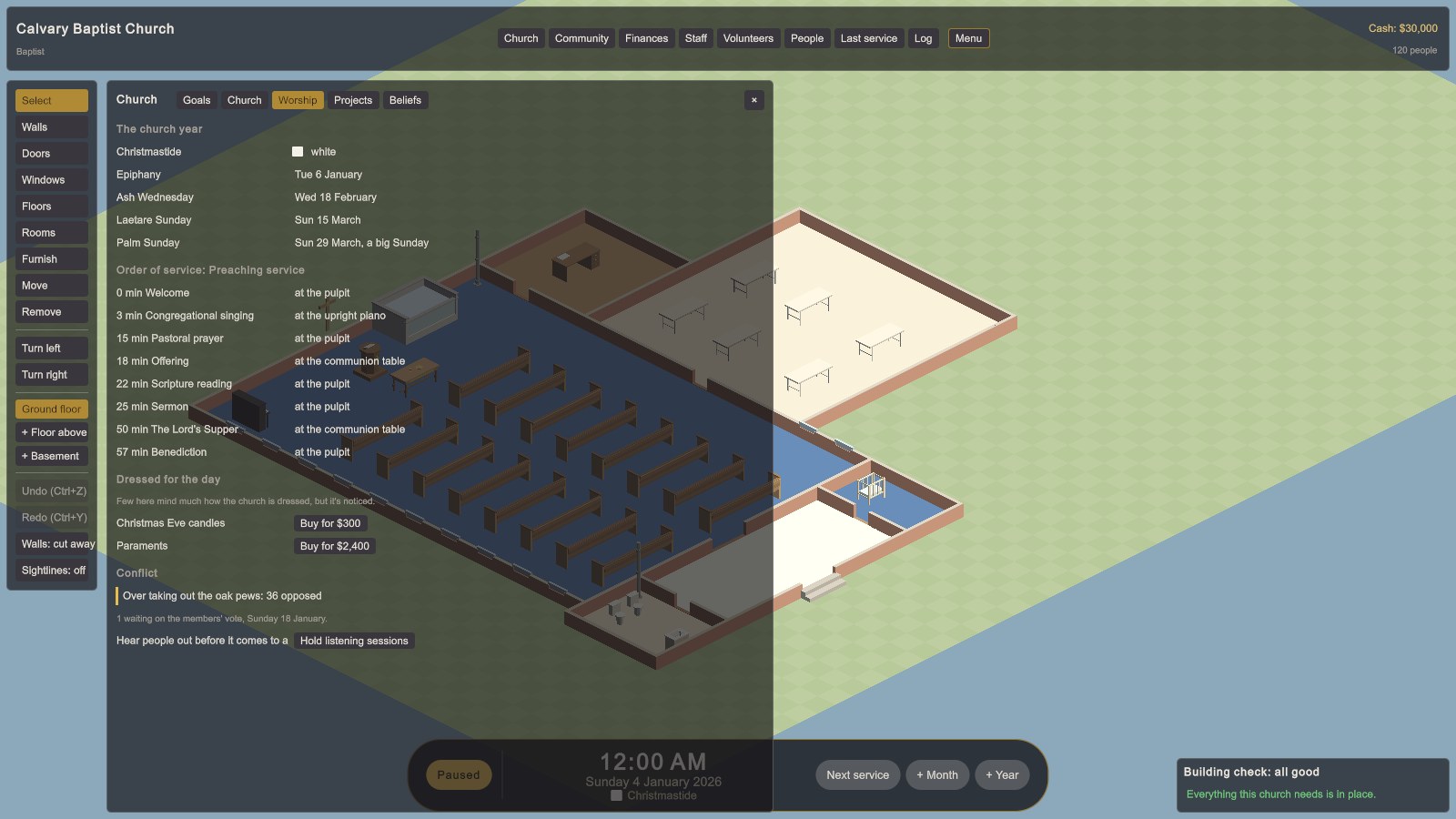
- People who have come longest oppose it most: 5% of newcomers, up to 90% of those who've come 21 years or more. The more pews go, the stronger the opposition.
- Until it's settled, opponents grumble: −0.06 after every service.
- In congregational churches (Baptist, Pentecostal, Quaker), it goes to a members' vote in two weeks. If it carries, the pews go, opponents lose 0.1, and one opposing household in ten leaves. If it fails, nothing changes.
- Where clergy or a board decide, the pews go at once. Four weeks later the opponents, never asked, lose 0.15, and one opposing household in four leaves.
Changing the seating without losing people
- Consult first. Hold listening sessions (Church → Worship, once per conflict) takes 40% off everyone's opposition.
- Do it in one go. Take out everything you mean to at once, so it's one fight, not several.
- Or don't take them out. Add chairs in new space instead.
- Change your mind. Putting everything back before it comes to a head ends the conflict.
Pews you placed yourself less than a year ago go quietly.