Chapter 3
Growing the congregation
Growth is a funnel. New households walk in; some are welcomed well enough to come back; a few of those become regulars; regulars become members. Each stage has its own levers, and a church grows when it does well at every stage at once.
Stage 1: newcomers walk in
Each week, new households visit at a rate of:
(0.3 + 0.004 × active people) × visibility × feasts × ministries and standing × lot × scenario
- Size helps itself. 100 active people draw about 0.7 new households a week; 300 draw about 1.5.
- Visibility. A Steeple and bells makes the church 25% more visible. Visibility is capped at +50% in all.
- Feasts. Christmas and Easter bring three times the usual new households, and Christmas Eve four times. Be ready for them, with seats, greeters, and the season's decor.
- Ministries. Each adds newcomers: a preschool +15%, a food pantry +8%, a youth group +5%, a choir +3%. The church's standing in the community above 0.3 adds more: 0.5 brings a fifth more. See The church in its community.
- Outreach. A mailing to 300 homes ($225) usually brings 3 to 6 households over the next few Sundays, on top of the usual newcomers.
- The lot. A city lot brings 1.3 times the walk-ins of a suburb; a country lot 0.7 times.
- A change of practice draws people looking for just that, for a year (see Traditions, beliefs and stances).
Stage 2: the first impression
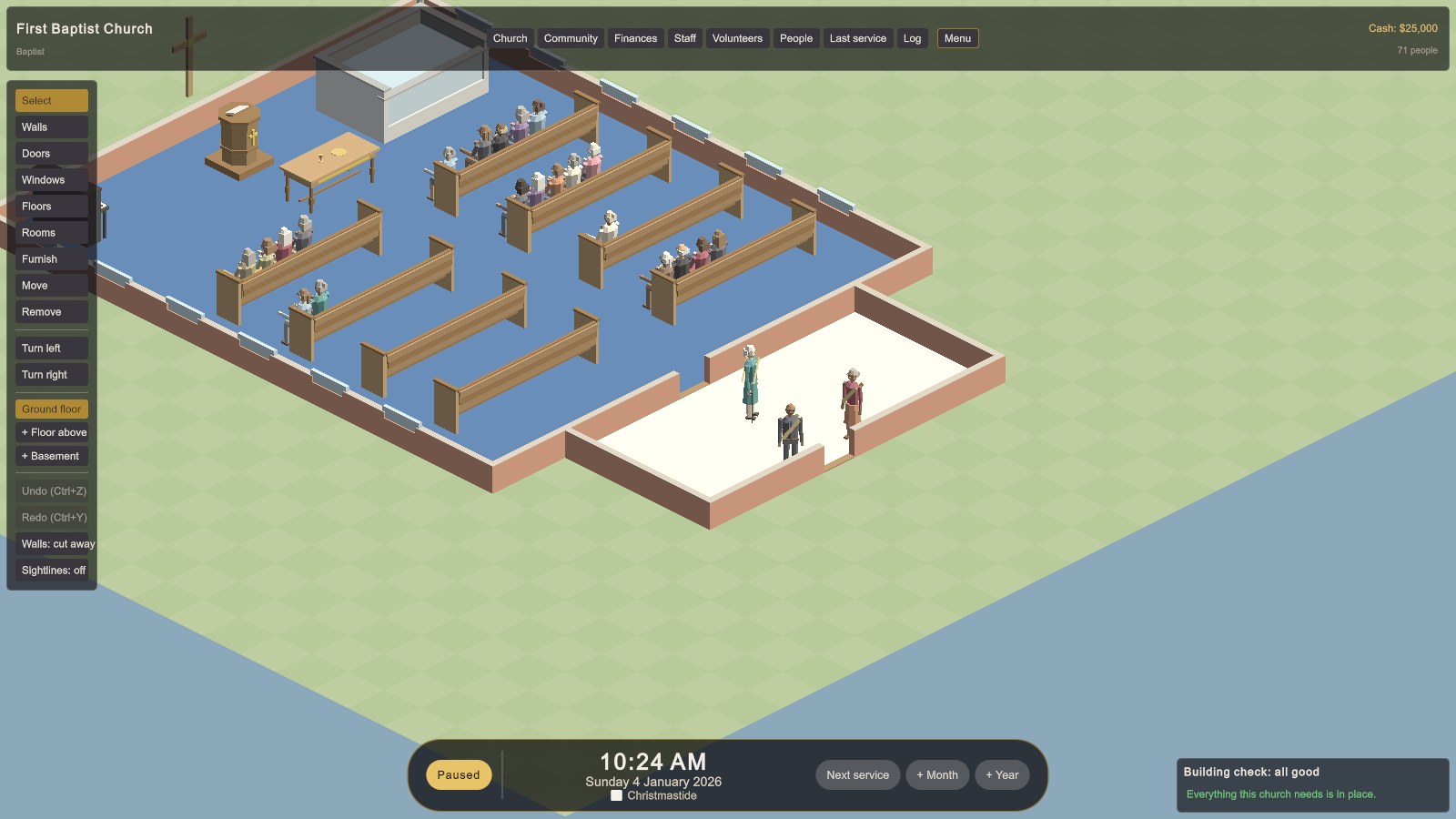
A visitor's satisfaction moves 60% of the way to their first service's target, so the first Sunday is everything. The biggest single factor is being welcomed: +0.15 if greeted, −0.1 if not, a swing of 0.25. The chance of being greeted is:
| Source | Adds to the chance |
|---|---|
| Base | 0.2 |
| An entrance hall (a narthex: an enclosed room with the outside door) | +0.45 |
| A crowd around (up to) | +0.15 |
| Two greeters on duty | +0.25 |
A church with a narthex and two greeters welcomes nearly everyone (up to 95%). One where visitors walk straight into the nave with nobody at the door welcomes one in five. Ushers showing them to a seat add another +0.03.
A narthex and two greeters on duty at every service are the single best investment in growth. Greeters cost nothing.
Everything else a visitor feels counts too, and counts hard: a seat (+0.05) or standing (−0.15), a restroom when they need one, a nursery for their baby, the sermon, and the building.
Stage 3: coming back
A visiting household comes back each week with a chance of (satisfaction − 0.5) × 1.5, capped at 50%.
| Visitor's satisfaction | Chance of returning each week |
|---|---|
| 0.5 or less | never |
| 0.6 | 15% |
| 0.7 | 30% |
| 0.83 or more | 50% |
After three visits at 0.55 or more, a household becomes regular. A visiting household that hasn't been back in four weeks is gone.
Stage 4: belonging
Regulars who have attended for a year and are at least 0.5 become members at 15% a month. Members come more often (+0.1 to their chance of attending) and pledge far more readily (see Money).
Friendships form by themselves between people who sit together, and they hold households in place. Each friend at the same service adds +0.03 (up to +0.1), and each friend in the church makes drifting away 15% less likely. Grudges form the same way and cost −0.05 when someone they resent is at the same service.
Why churches shrink
- Households drift away below 0.45 satisfaction.
- 3% of households move away each year, whatever you do.
- People die, and older congregations lose more.
- Grown children leave home at a fifth a year: half stay in the church with a household of their own, half move away.
- Conflicts and changes of practice drive some away (Projects, approvals and conflict, Traditions, beliefs and stances).
A church that welcomes poorly loses visitors faster than it gains them, and natural losses do the rest. That's the "dying parish": not a disaster, just a slow leak.
The People screen
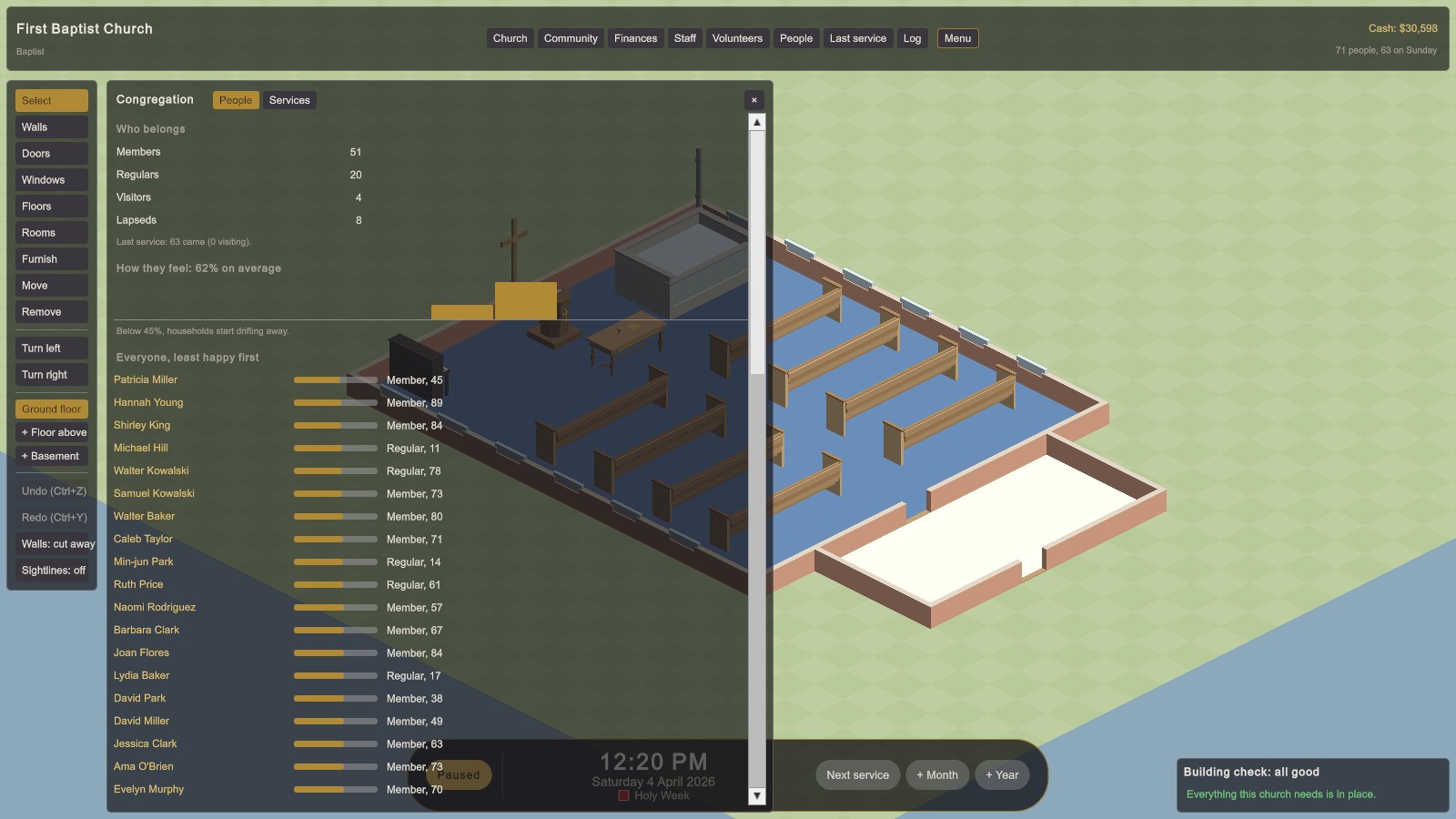
People has two tabs. People counts who belongs and charts their satisfaction, with a line at 45% where households start to drift. Below that, everyone is listed least happy first with their status and years attending. Click a name to open their inspector and bring them into view. Work down from the top of the list: the least happy are the ones about to leave.
Services
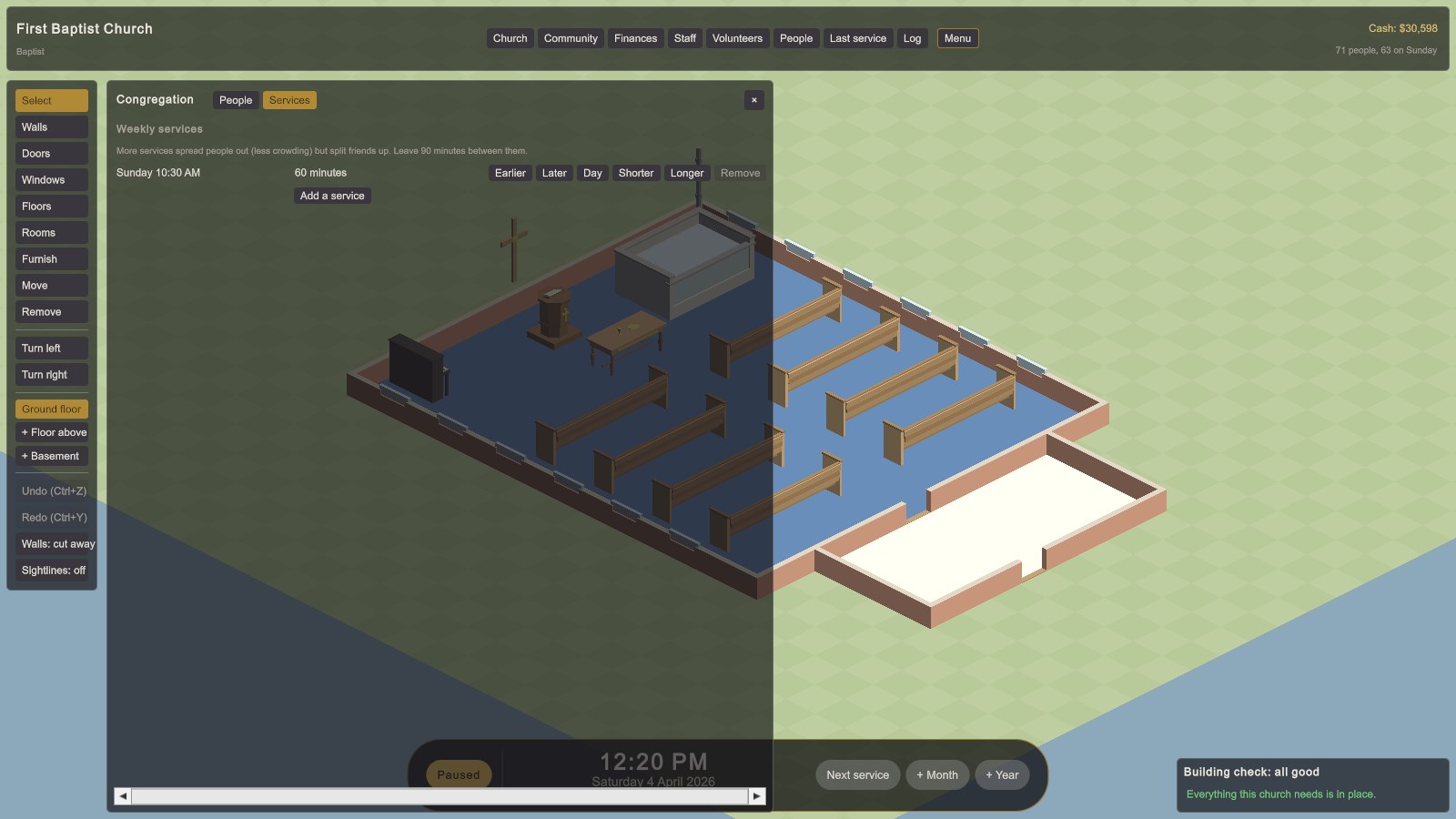
A church can hold up to four services a week. Each household keeps to one. More services spread people out, so there's less crowding and fewer people standing, but they split friends up. Leave 90 minutes between services. Remember that every extra service needs its own greeters, ushers, and nursery workers on duty (see Staff and volunteers).
A growth plan that works
- Welcome: a narthex with an outside door, two greeters and two ushers at every service.
- Seat everyone: seats for your busiest service and for Christmas and Easter, or add a service.
- Meet needs: a restroom with plumbing, and a nursery with a nursery worker on duty.
- Fix what the tradition requires, then what it expects.
- Reach out: a classroom for a preschool, a hall for a food pantry, and a mailing every month or two.
- Keep people: watch the bottom of the People list, and fix what their last-service factors show.