Chapter 8
Money
A church has to pay its way. Money comes mostly from its people's giving, which follows their satisfaction, and goes mostly on staff and the building. This chapter explains every source of income and every cost, the four finance screens, and how to borrow without sinking.
The finance screens
Finances on the top bar opens four tabs. Every figure is read from the church's ledger.
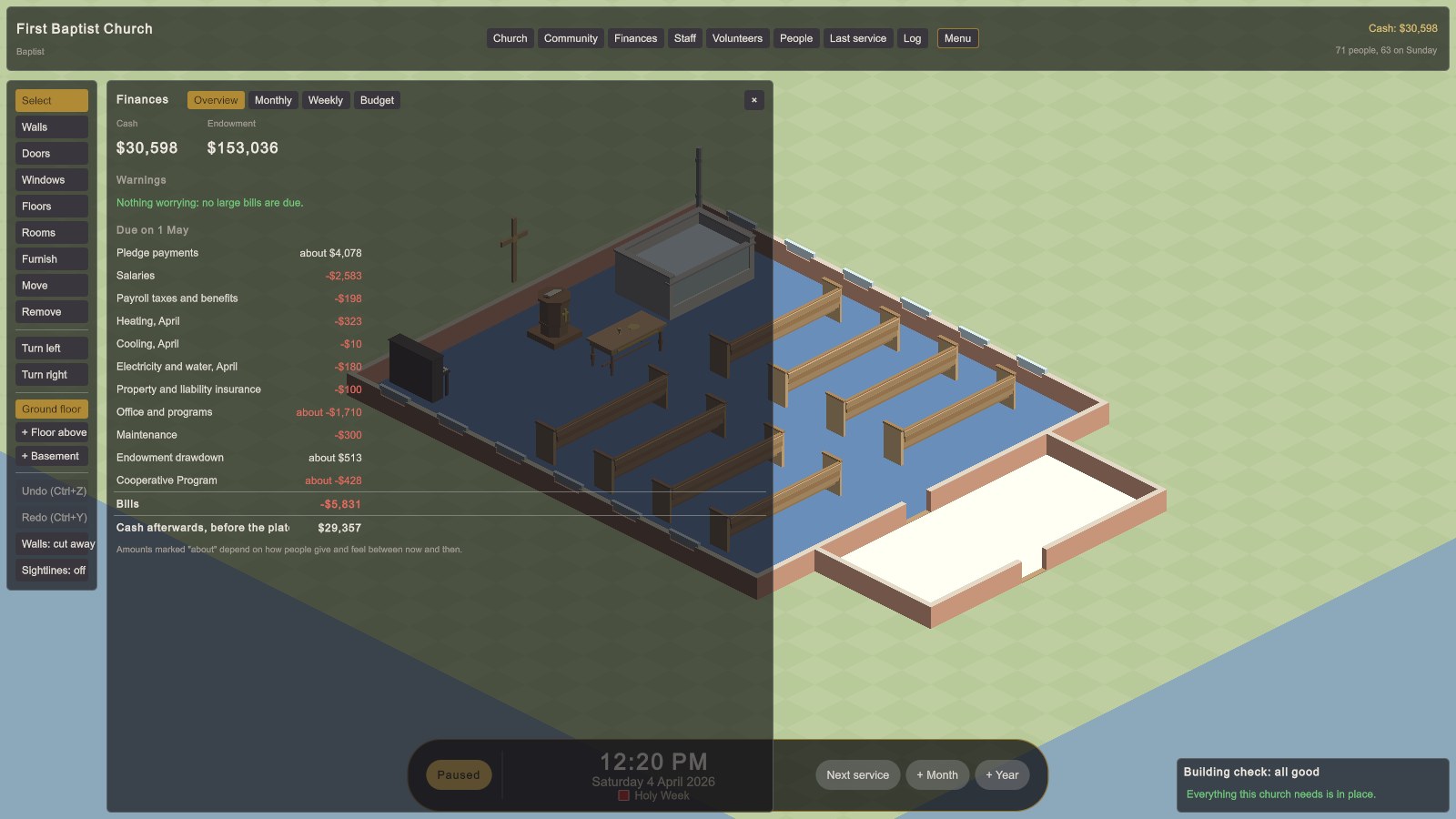
- Overview: the balances (cash, endowment, and any campaign fund), warnings, most serious first, and what the 1st of next month will bring, line by line, ending with the cash you'll have afterwards before the plate.
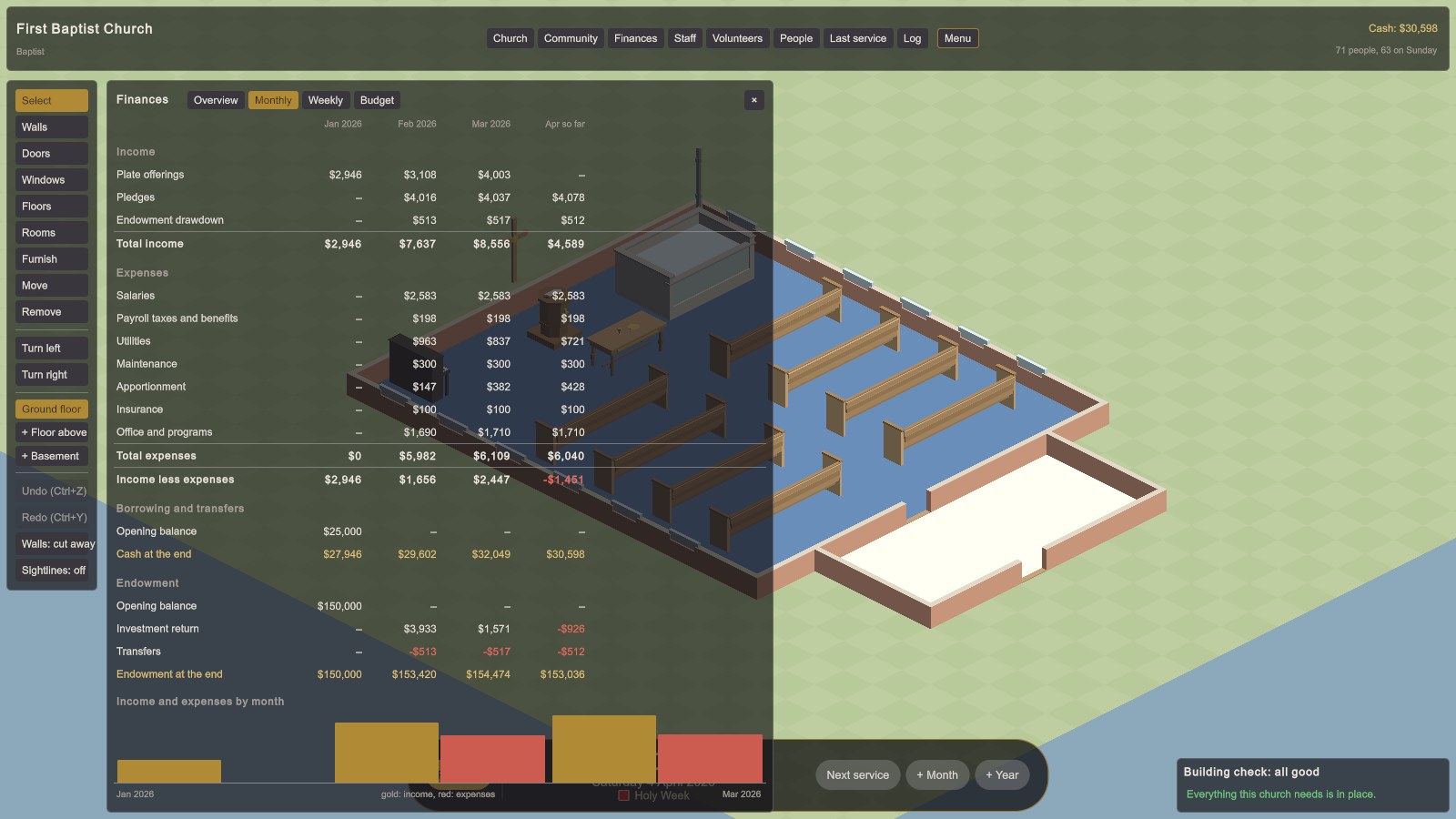
- Monthly: the last five monthly statements and the month so far, by category, with each fund's closing balance and a chart of a year's income against expenses.
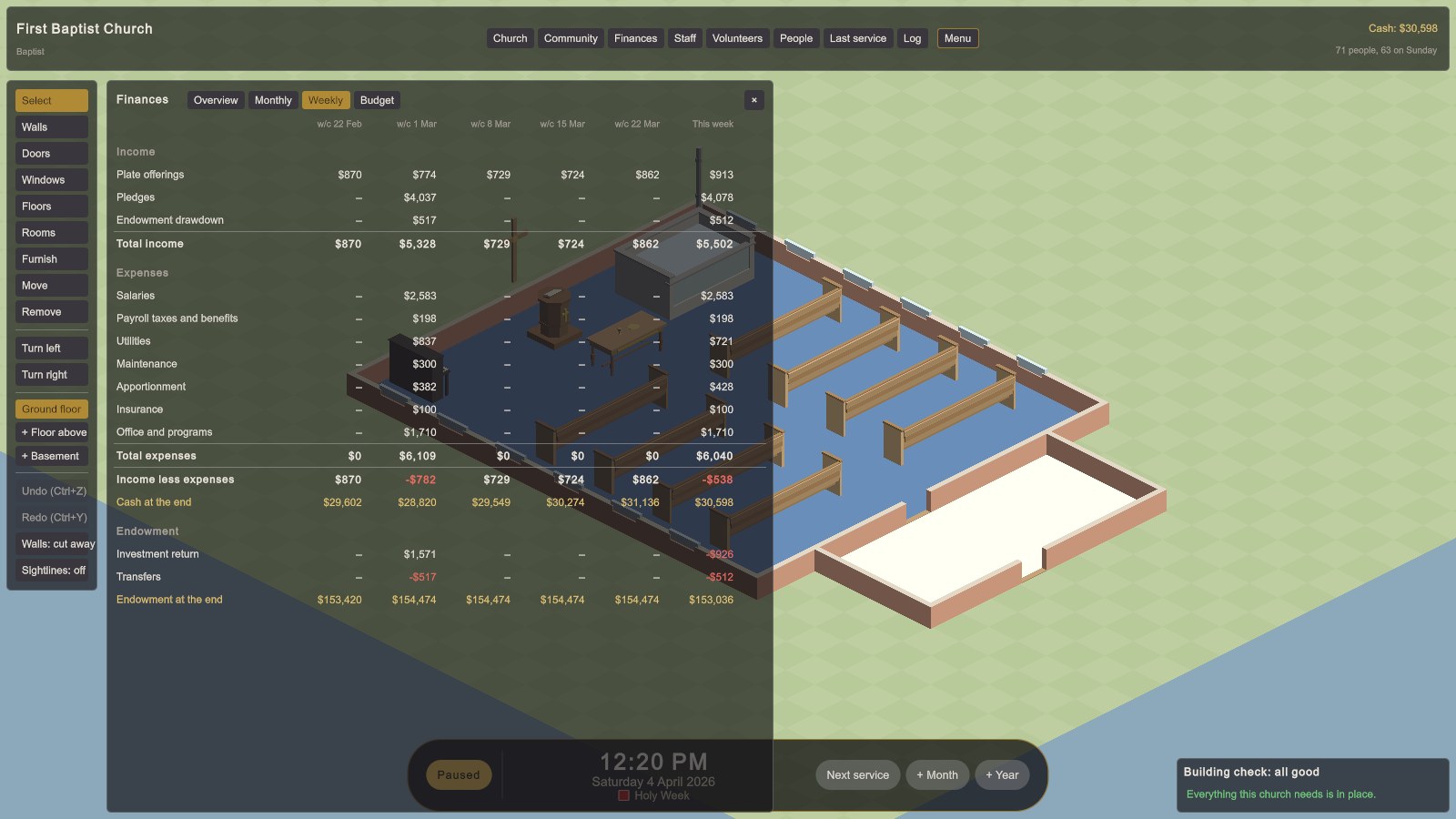
- Weekly: the last six Sunday-to-Saturday weeks, which add up exactly to the monthly statements.
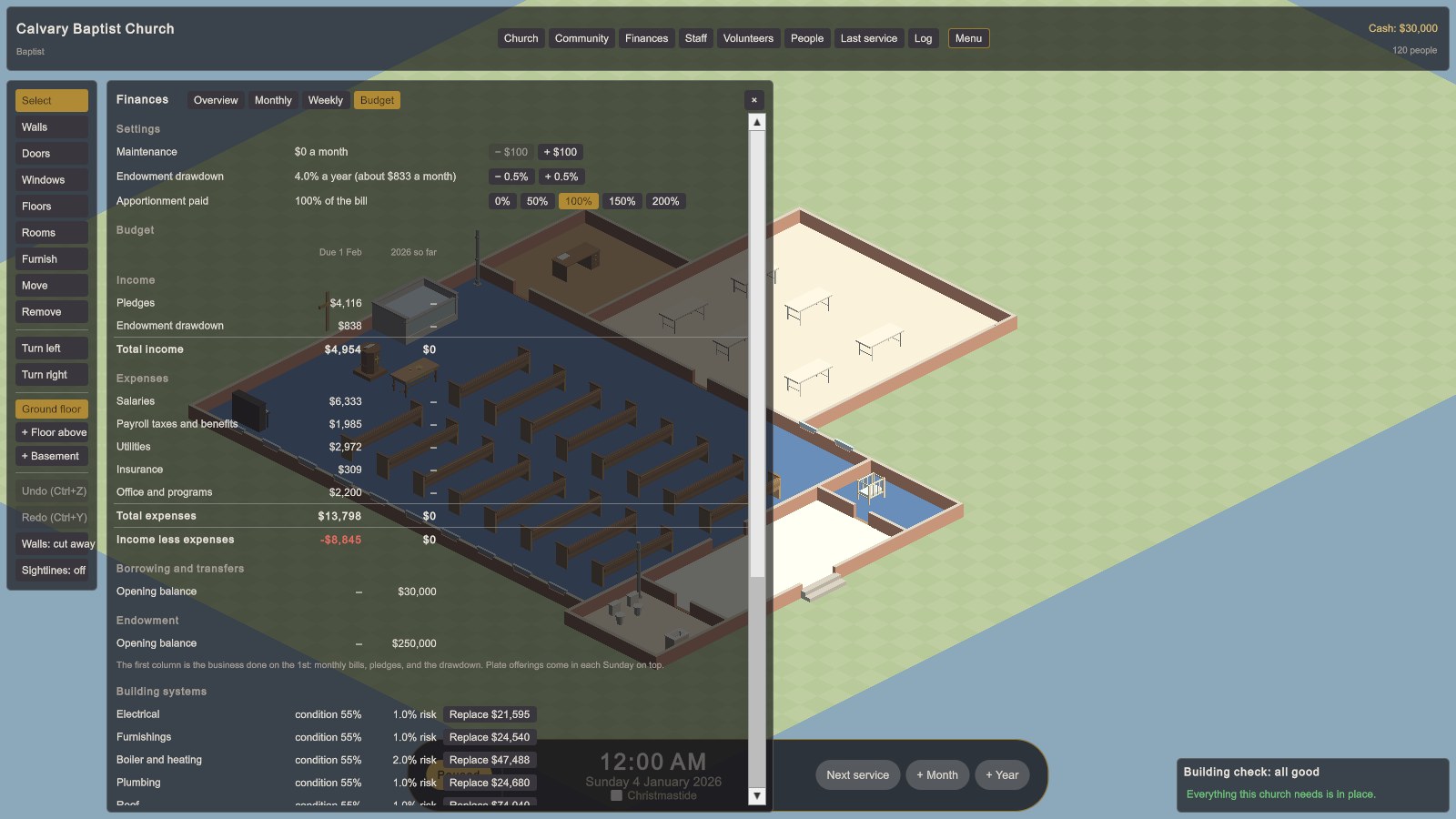
- Budget: the settings (maintenance budget, endowment drawdown, apportionment share), what's due next against this year and last, each building system's risk with a button to replace it, the staff's cost, and the forms to start a capital campaign and take a loan.
Warnings
The Overview warns you, a month ahead, about:
- an overdraft, or bills on the 1st that would cause one;
- any building system with a 4% or greater chance of failing next month (a stronger warning if the repair would empty the account);
- spending more than came in, three months running;
- unpaid apportionment.
"Spending more than came in for three months running" is the earliest sign of a slow slide. Act on it before it becomes an overdraft.
Where money comes from
Giving capacity and engagement
Each adult has a giving capacity: what they could give in a year if fully committed. It averages about $3,500 (roughly a tithe on a typical income), less for new visitors. How much of it they actually give depends on engagement, which follows satisfaction: nothing below 0.25, rising in a straight line to full at 0.8.
The plate
The offering is taken at every service:
- A household that hasn't pledged gives about capacity × 0.8 × engagement ÷ 52, give or take 30%.
- A pledging household drops in a few dollars of loose cash.
- A visiting household gives $5 to $25.
Summer holidays thin attendance (June by 7%, July and August by 15%), so the plate dips in summer. Pledges keep coming.
Pledges
- Every November a pledge drive runs for the next year. A household with a member pledges with a chance of 0.9 × engagement; a household of regulars only, 0.3 × engagement.
- The pledge is about capacity × 0.75 × engagement.
- Pledges are paid monthly from January. Each month's payment is scaled by 0.5 + 0.6 × engagement (at most 1), so unhappy households fall behind. Households that leave stop paying.
- Opening the books (a new game) runs a drive for the current year.
Be at your happiest in November, and turn regulars into members: members are three times as likely to pledge. A church of 200 at 0.6 satisfaction gives about $1,600 a year per attender, roughly $225,000 in all.
Capital campaigns
A campaign raises money for one purpose over 3 to 36 months, one at a time (Budget → Capital campaign: choose the purpose, goal, and length).
- Each active household commits with a chance of engagement × the cause's popularity, and gives about capacity × 0.6 × engagement × popularity, spread over the campaign.
- Popularity: expansion 1.0, accessibility 0.9, repairs 0.8, music 0.6.
- Gifts go to the campaign fund. Construction, furnishings, and repairs are paid from that fund first, then from cash.
- A happy congregation of 150 raises about $160,000 over a year for an expansion, and about $45,000 for a new organ.
The endowment
- It earns about 6% a year on average, varying about 12% either way from year to year.
- Each month, the drawdown you set (0 to 10% a year, 4% by default) moves into cash.
- A member who had attended ten years or more leaves the endowment a bequest a quarter of the time when they die: 2 to 15 times their yearly giving capacity.
Spend the endowment's income, not the endowment: a drawdown of 4 to 5%. Above about 5 to 6%, you're eating the capital that pays for the future.
Other income
| Source | Amount | Notes |
|---|---|---|
| Weddings of your own couples | $400 | Young adults in the church marry at about 5% a year. |
| Outside weddings | $2,500 | Up to one a month for a formal, handsome church. |
| Funerals | $300 | For each of your people who dies. |
| Rentals | $100 to $1,500 a month | See The church in its community. |
| The preschool | about +$1,500 a month net | Tuition covers the teachers and a little more. |
| Denominational support | varies | In the suburban plant, a $4,000 monthly grant for four years. |
| Insurance | varies | In the fire-damaged church, $1.4 million at the start. |
Where money goes
| Cost | How it works |
|---|---|
| Staff | About 55% of a typical church's spending. Salaries, plus 7.65% payroll taxes, plus $18,000 benefits for a full-time pastor. See Staff and volunteers. |
| Utilities | Heating and cooling follow the climate, the volume (floor area × ceiling height), and the style's heat loss; electricity and water $0.90 per m² a month. A Gothic nave (9 m ceilings, 1.3× heat loss) costs several times a brick one to heat. Only floored space inside walls is heated. Bills are paid on the 1st of the following month. |
| Insurance | $6 per m² a year. |
| Maintenance | The budget you set, plus each item's upkeep. See Keeping the building standing. |
| Repairs | When a building system fails: 10 to 50% of its replacement cost. |
| Office and programs | $1,000 a month plus $10 per active person, plus ministries' costs, mailings, and the live stream. |
| Apportionment | To the denomination, a share of operating income: Catholics 10%, Lutherans 7%, Baptists 5% (the Cooperative Program, voluntary). The Orthodox, Pentecostal, and Quaker churches owe nothing. You set how much of the bill to pay (0% to 200%) in Budget. See Traditions, beliefs and stances. |
| Rent | In the suburban plant, $2,500 a month until the church has a building of its own. |
| Loan repayments and interest | See below. |
Debt
- Loans cost 6.5% a year, over 1 to 30 years, up to $5 million in all. Take one in Budget → Loans.
- Overdraft costs 12% a year, and most scenarios are lost if it runs deep for months.
Never sit in overdraft when a loan costs about half as much. The Overview warns you a month ahead. Take the loan before you need it.
Rules of thumb
- A full-time pastor needs about 150 active people to pay for. Below about 75, a bivocational pastor is the difference between solvency and an overdraft.
- Fund building projects with a campaign first, then a loan, never the overdraft.
- Hire a choir director / organist once you average a surplus of about $2,500 a month.
- In a crisis month, paying half the apportionment is a reasonable compromise. Paying nothing for long is not.
- A preschool pays for itself and brings the most newcomers of any ministry.
- Small, steady maintenance is far cheaper than repairs.